
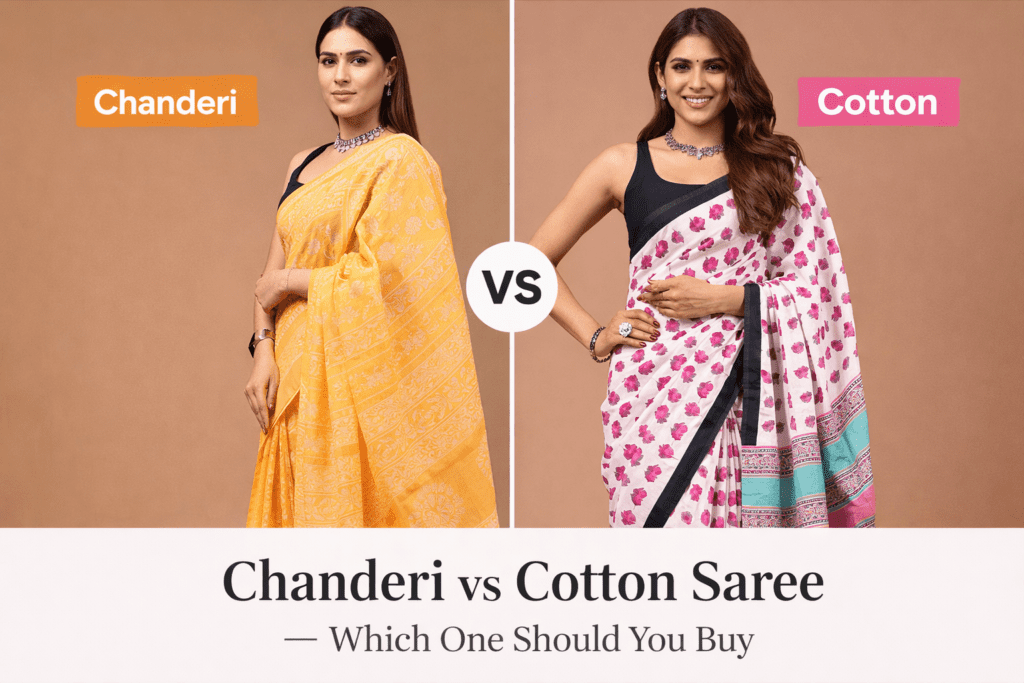
Silk-Cotton
Luminance
Woven in Madhya Pradesh. Sheer, light, with a natural silk sheen. The formal saree choice.
Earthy
Block Print
Hand printed in Bagru, Jaipur. Breathable, durable, deeply versatile. The everyday saree choice.
Both Chanderi and cotton sarees are beautiful. Both are block-printed at SA Fab. Both are available right now. The question — which one is right for you — has a real answer. It depends on three things: when you’ll wear it, how you’ll care for it, and what feeling you want when you put it on.
This guide gives you an honest, clear comparison between the two. Not marketing language — just the practical differences between the fabrics, the drape, the occasion, the care, and the price. By the time you finish reading, you’ll know exactly which one to reach for.
In this article
What is Chanderi Fabric?
From the looms of Chanderi, Madhya Pradesh — a fabric woven for centuries.
Chanderi fabric comes from the town of Chanderi in Madhya Pradesh — a weaving centre with a history stretching back over a thousand years. It is a blend of silk and cotton, typically in a ratio of around 70% cotton to 30% silk, though this varies by weaver. The silk yarns are woven through a cotton base, which is what gives Chanderi its defining quality: a lightweight body with a natural, subtle sheen.
The texture of Chanderi is often described as transparent or sheer. Hold a Chanderi saree up to the light and the weave is visible — it feels like layered air rather than solid cloth. This sheerness is not a flaw. It is the craft signature of the fabric, and one of the reasons it drapes so softly.
Chanderi sarees traditionally feature woven zari (gold or silver) motifs — coins, florals, peacocks, and geometric borders. At SA Fab, we use the Chanderi base fabric with Bagru hand block printing — so the Chanderi sheen carries natural dye motifs rather than machine-printed patterns. The result is more refined than either technique alone.
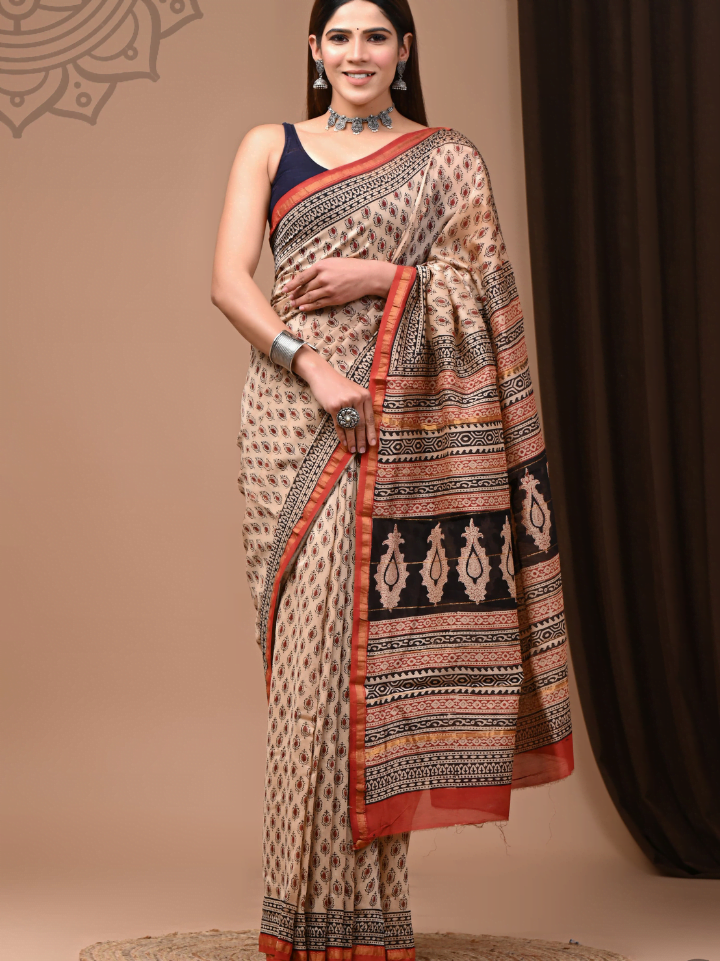
What is a Cotton Saree?
The most worn saree fabric in India — and for very good reason.
A cotton saree is woven entirely from cotton fibre — no silk, no synthetic blend. Pure cotton is one of the oldest and most reliable fabrics in the world. In India, it has been the dominant saree fabric for centuries — not because it was all that was available, but because it works. It breathes in heat, absorbs moisture before it feels damp, and holds colour well when naturally dyed.
At SA Fab, our cotton sarees are hand block printed in Bagru on pure cotton using natural dyes — the same Chhipa community tradition that has been practised in this village for over 450 years. The cotton base absorbs natural dyes deeply, producing colours with a warmth and richness that synthetic printing on cotton never achieves.
Cotton sarees have a slightly matte, textured surface. They drape with body — not as fluid as Chanderi, but with a natural structure that holds its shape through a long day. The weave is denser, the hand feel is earthier, and the overall look reads as grounded and confident rather than sheer and delicate.
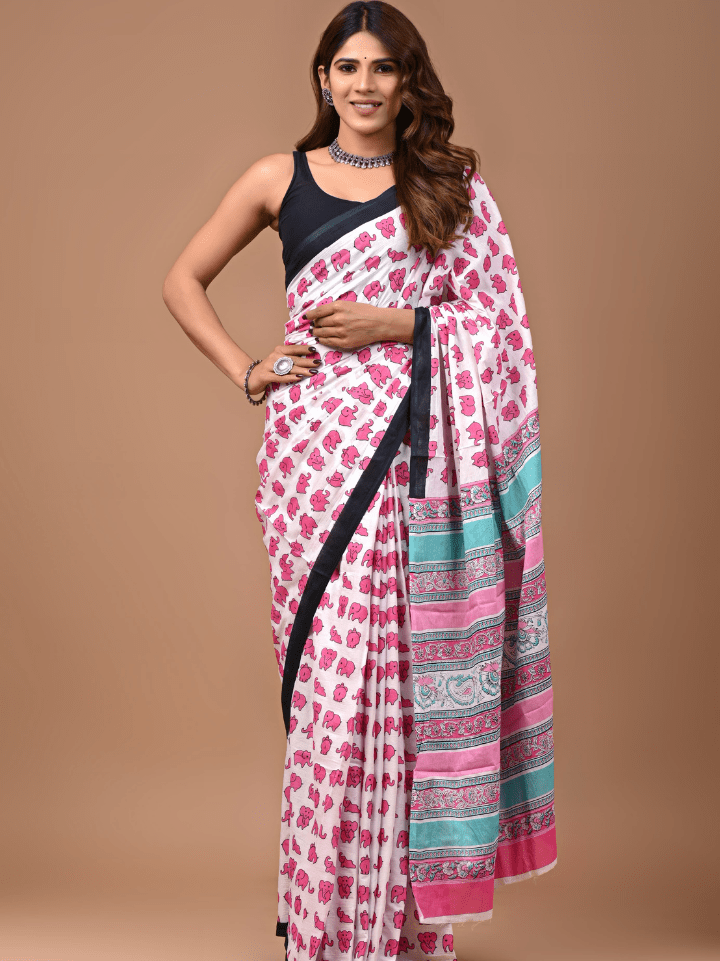
Drape & Feel — The Real Difference
This is where the two fabrics live in different worlds.
Chanderi Drape
- ◆ Flows and falls with almost no resistance — light as air
- ◆ Sheer, translucent texture — see-through in bright light
- ◆ Subtle silk sheen — catches light at different angles
- ◆ Pleats fall softly and loosely — elegant but needs re-draping
- ◆ Feels weightless against the skin
- ◆ Creases easily — needs care when carrying and storing
Cotton Drape
- ◆ Holds its shape with natural body and structure
- ◆ Opaque — solid, grounded look
- ◆ Matte surface — earthy, craft texture
- ◆ Pleats hold well throughout the day without constant adjustment
- ◆ Slightly heavier — more stable drape
- ◆ Resilient — easy to wash and wear again
The drape difference is the most important practical distinction between the two. If you are wearing the saree for a few hours at a formal occasion and you have help draping it — Chanderi’s fluid fall is stunning. If you are wearing the saree through a full day — office, travel, festival, or outdoor event — cotton’s structure and stability is more practical.
Chanderi is the saree you wear when the moment is the occasion. Cotton is the saree you wear when your whole day is the occasion.— SA Fab · Handblock Prints Bagru, Jaipur
Best Occasion for Each
The honest answer to when to reach for which.
- ◆ Weddings — as a guest or family member
- ◆ Festive evenings — Diwali, Eid, Durga Puja
- ◆ Formal occasions where drape will be maintained
- ◆ Occasions in cooler indoor settings
- ◆ Photography or events where sheen photographs well
- ◆ Office and professional wear — all day comfort
- ◆ Casual outings — lunch, travel, shopping
- ◆ Navratri and active festival wear
- ◆ Summer months — maximum breathability needed
- ◆ First saree buyers — forgiving and easy to maintain
Full Comparison Table
Every dimension that matters, side by side.
| Feature | ✦ Chanderi Saree | ✦ Cotton Saree |
|---|---|---|
| Fabric Composition | Silk + cotton blend (~70:30) | 100% pure cotton |
| Texture | Sheer, translucent, silky | Opaque, matte, earthy |
| Weight | Very light — almost weightless | Slightly heavier — structured |
| Drape Quality | Flowing, fluid, elegant | Structured, holds pleats well |
| Breathability | Good — better indoors | Excellent — best in summer heat |
| Sheen / Shine | Yes — natural silk lustre | No — natural matte finish |
| Block Print Quality | Good — sheen adds depth to print | Excellent — deep dye absorption |
| Best Occasion | Weddings, formal, festive evenings | Daily, office, casual, summer festivals |
| Durability | Moderate — delicate weave | High — very durable, long-lasting |
| Wash Care | Dry clean or very gentle hand wash | Cold hand wash at home |
| Price at SA Fab | ₹1,999 – ₹2,499 | ₹780 – ₹1,599 |
| Available at SA Fab | Shop Chanderi → | Shop Cotton → |
Which is the Best Fabric for Summer Saree?
The most searched question — answered honestly.
For Indian summers — where temperatures cross 40°C and humidity is high — pure cotton is the better choice. Cotton absorbs up to 20% of its weight in moisture before it feels damp, allows air to circulate freely against the skin, and has no synthetic components that trap heat. A block printed cotton saree in summer keeps you genuinely comfortable for hours.
Chanderi, while lighter in weight, has a silk component that does not breathe as freely as pure cotton. It is more comfortable in air-conditioned indoor settings — weddings, formal events, evening occasions — than in outdoor heat. That said, because Chanderi is so light, it does not feel as heavy or suffocating as silk or synthetic fabrics in warm weather.
- Absorbs more moisture before feeling damp — critical in humid summers
- Completely breathable — no synthetic or silk fibres trapping heat
- Natural dyes (madder, indigo, harda) add no chemical coating to the fabric
- Washes easily at home — cold water, dry in shade, ready the next day
- Available from ₹949 — practical enough to wear without worry
- The silk sheen reads as elevated and dressy — appropriate for weddings and formal events
- The sheer drape photographs beautifully — essential for occasions where you’ll be in pictures
- Lightweight enough to wear comfortably even in warm indoor settings
- Block printed Chanderi from Bagru has a distinctiveness that plain sarees lack
How to Care for Both
The right care keeps both fabrics beautiful for years.
Frequently Asked Questions
The most common questions about Chanderi and cotton sarees.
You Might Also Like
Chanderi or Cotton.
Both from Bagru.
Hand block printed by Chhipa artisans using natural dyes. Free shipping across India. 7-day returns on every order.