

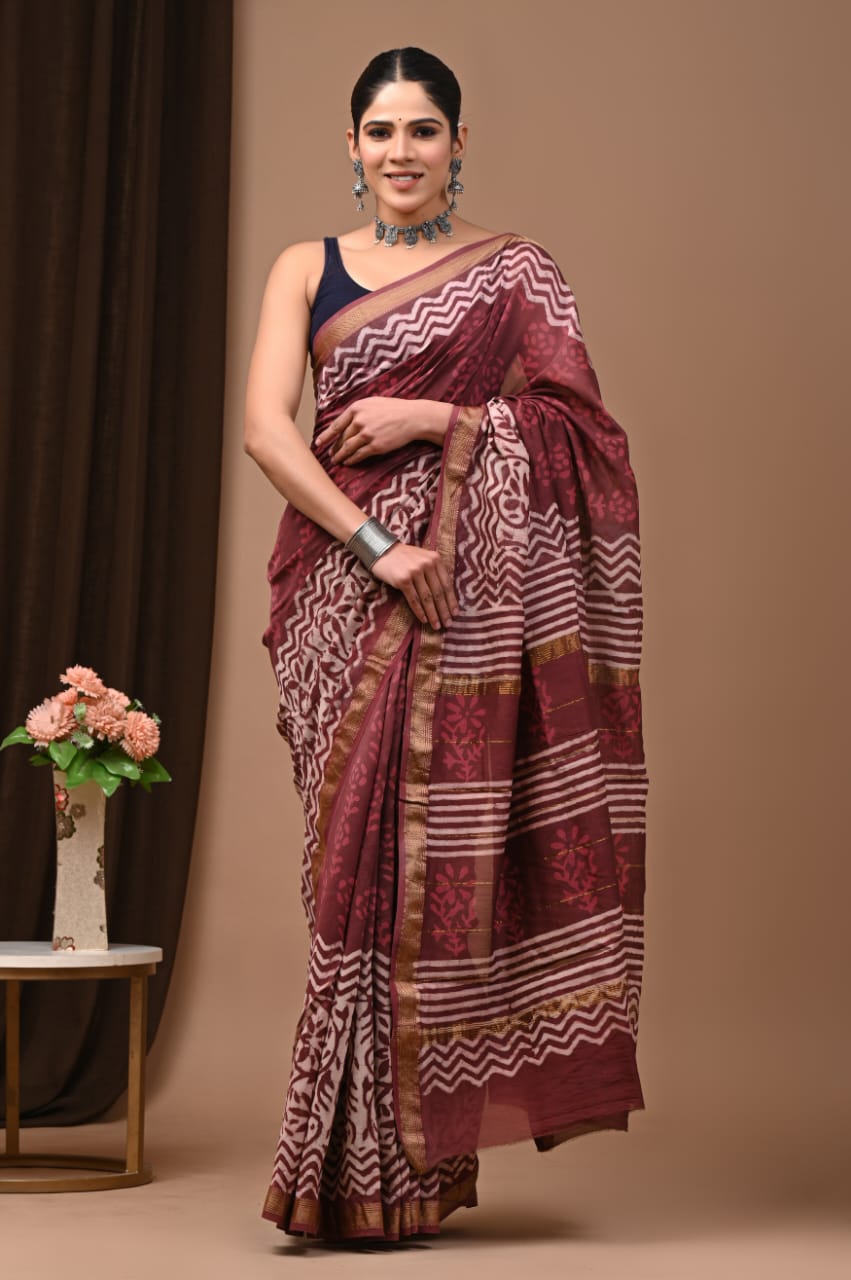
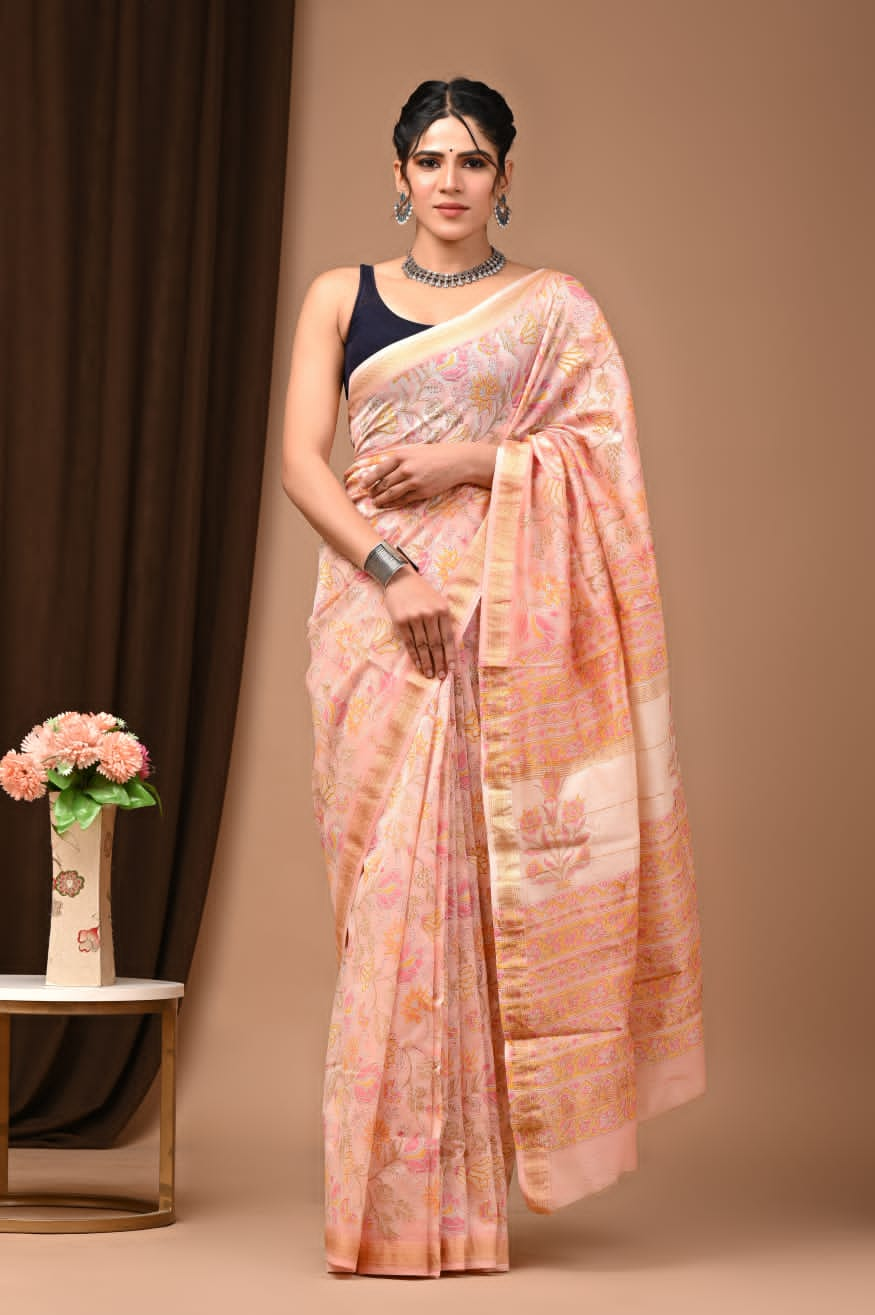
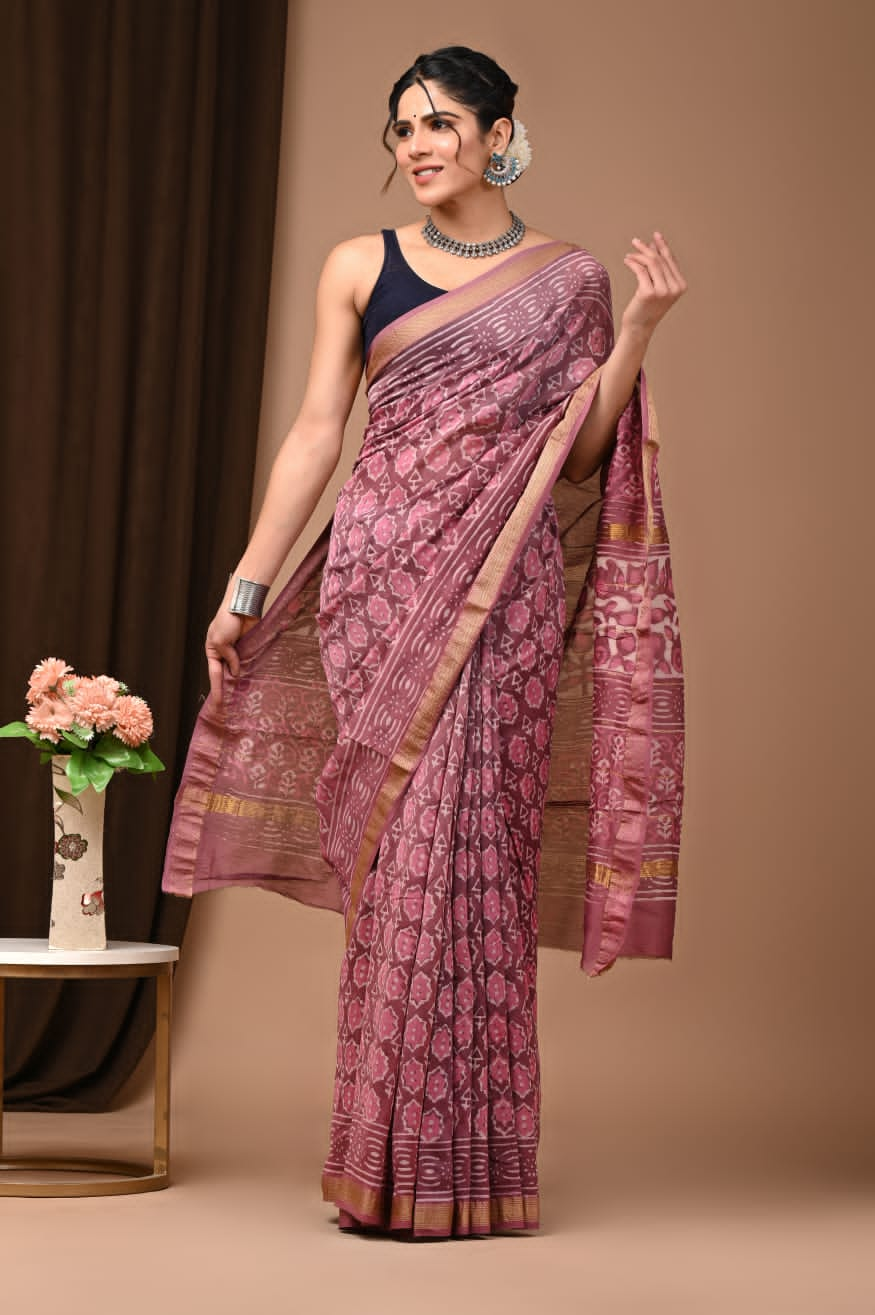
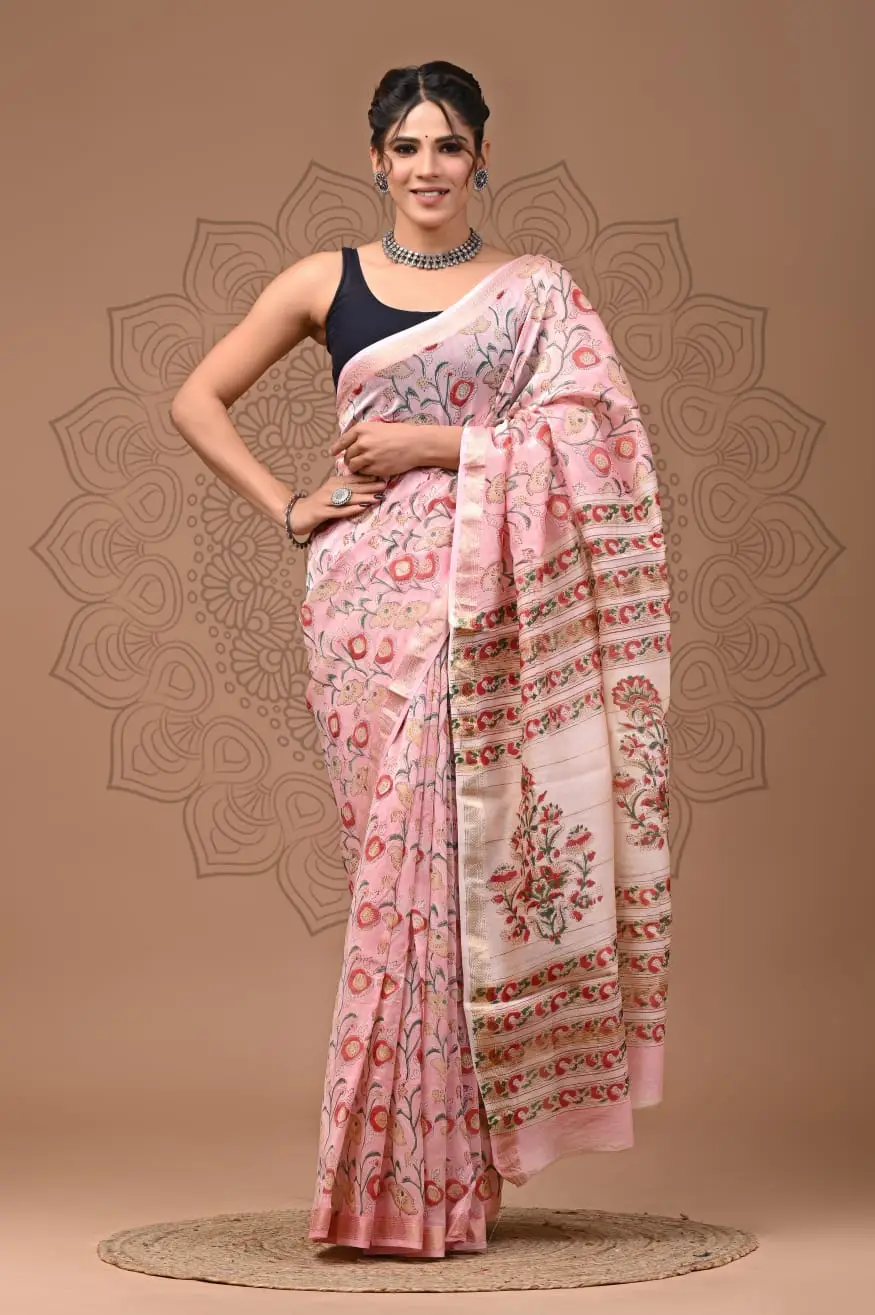
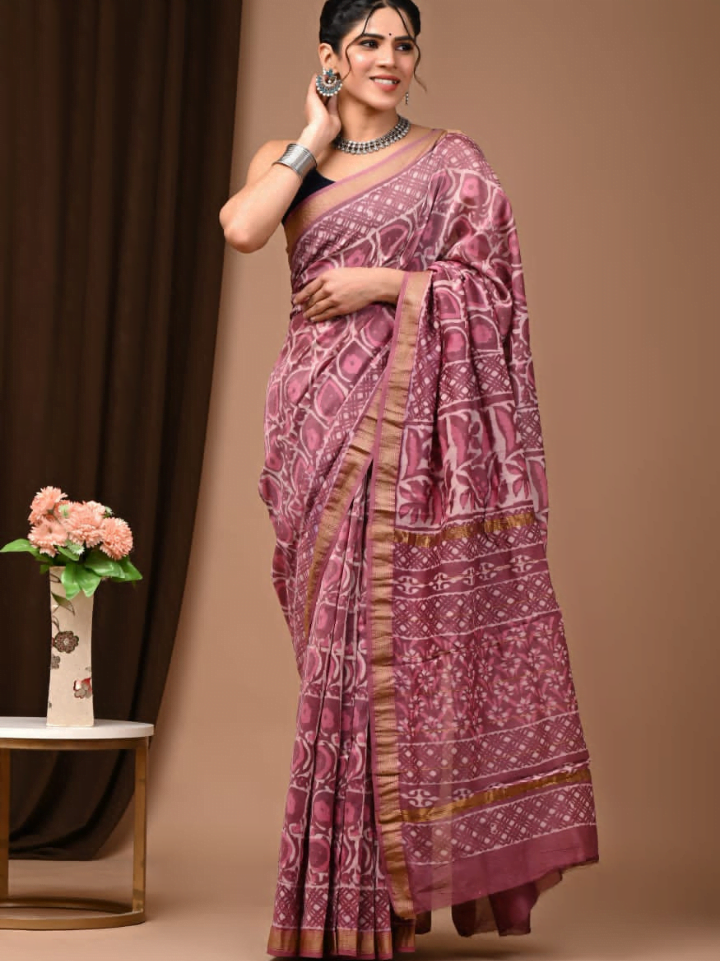
Block Printed Maheshwari Saree — Handwoven Silk, Printed in Bagru
Our Maheshwari sarees combine two of India’s most distinct handcraft traditions. The fabric itself is handwoven in Maheshwar, Madhya Pradesh — the town where Queen Ahilyabai Holkar established this weaving tradition in the 18th century for royal guests. The block printing is done in Bagru, Rajasthan, by Chhipa community artisans who have practised natural dye printing for over 450 years. The result is a saree that carries two craft legacies simultaneously — the handwoven silk-cotton structure of Maheshwar and the hand-pressed natural dye print of Bagru.
Most brands selling Maheshwari sarees offer either the plain woven fabric or a machine-printed version. We do neither. Every Maheshwari silk saree in this collection is handwoven on pit looms in Maheshwar and then hand block printed by Chhipa artisans in Bagru using natural dyes. This is SA Fab’s specific and verifiable combination — and no factory intermediary sits between these artisans and you.
For a complete understanding of the Maheshwari weaving tradition, its history, and how to identify an authentic piece, read our published guide: What is a Maheshwari Saree.
What Makes Maheshwari Fabric Different from Other Silk Sarees
A pure Maheshwari silk saree uses a specific thread construction. The warp — the lengthwise threads — uses fine silk yarn. The weft — the crosswise threads — uses fine cotton yarn. This silk warp and cotton weft combination is what gives Maheshwari fabric its distinctive character: it has the sheen and drape quality of silk, but it breathes more freely than a pure silk saree because of the cotton weft running through it.
The result is a saree that feels lighter than pure silk, drapes more crisply than georgette, and maintains a gentle lustre without the heaviness of a Banarasi or Kanjivaram. Maheshwari fabric is structured enough to hold a clean pleat but soft enough to drape in a fluid fall. Because of this balance, it suits a wider range of occasions than many silk sarees — from office wear to weddings to daily festive dressing.
Three physical features identify an authentic Maheshwari saree. First, the reversible border — known as the bugdi border — looks identical on both sides of the fabric. Second, the pallu carries five characteristic stripes. Third, the fabric has a slight stiffness to the hand when held — from the structured silk warp — that distinguishes it from softer, more fluid silk blends. For a full guide to authenticating a Maheshwari saree, including the burn test, read our detailed Maheshwari saree guide.
What’s in This Collection
20 block printed Maheshwari sarees across three distinct print traditions. Here is how to navigate them:
Bagru Block Print Maheshwari Sarees
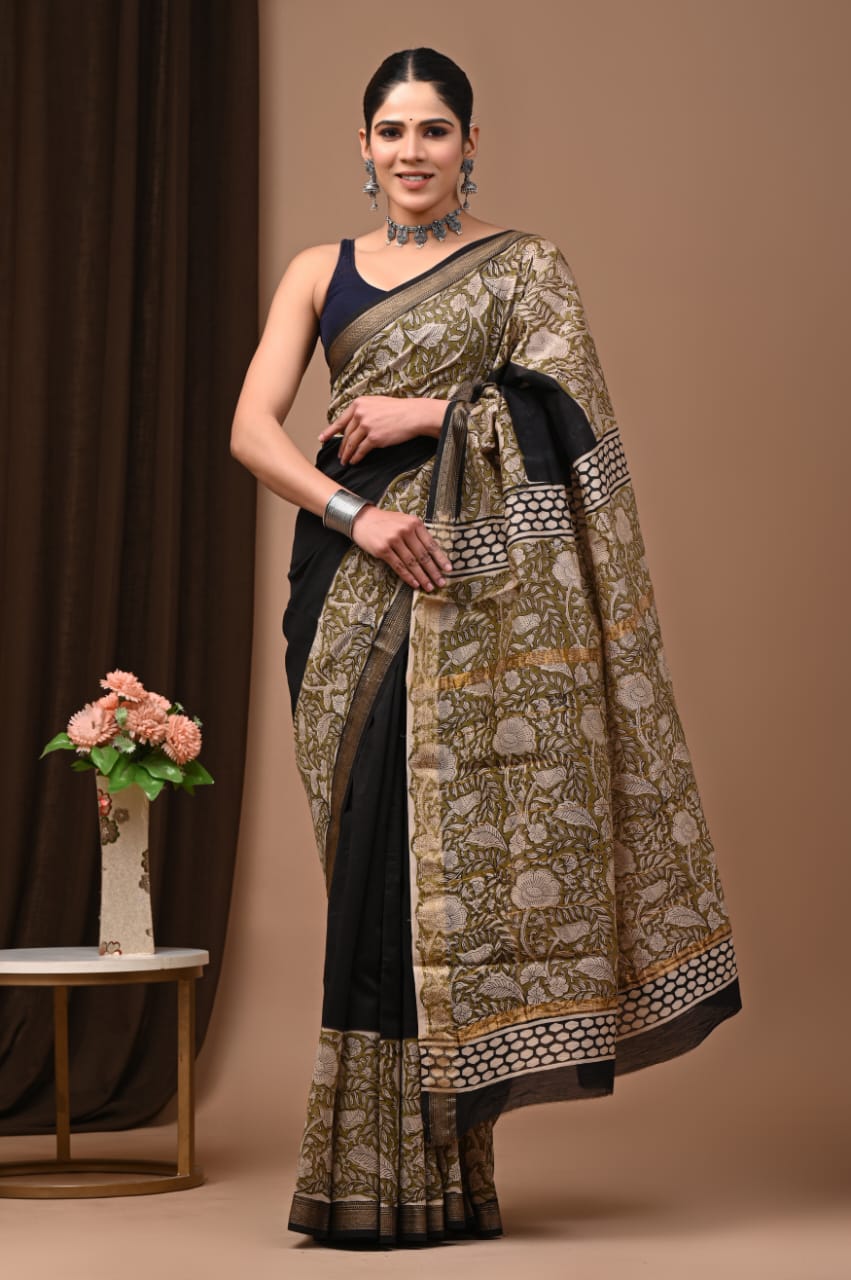
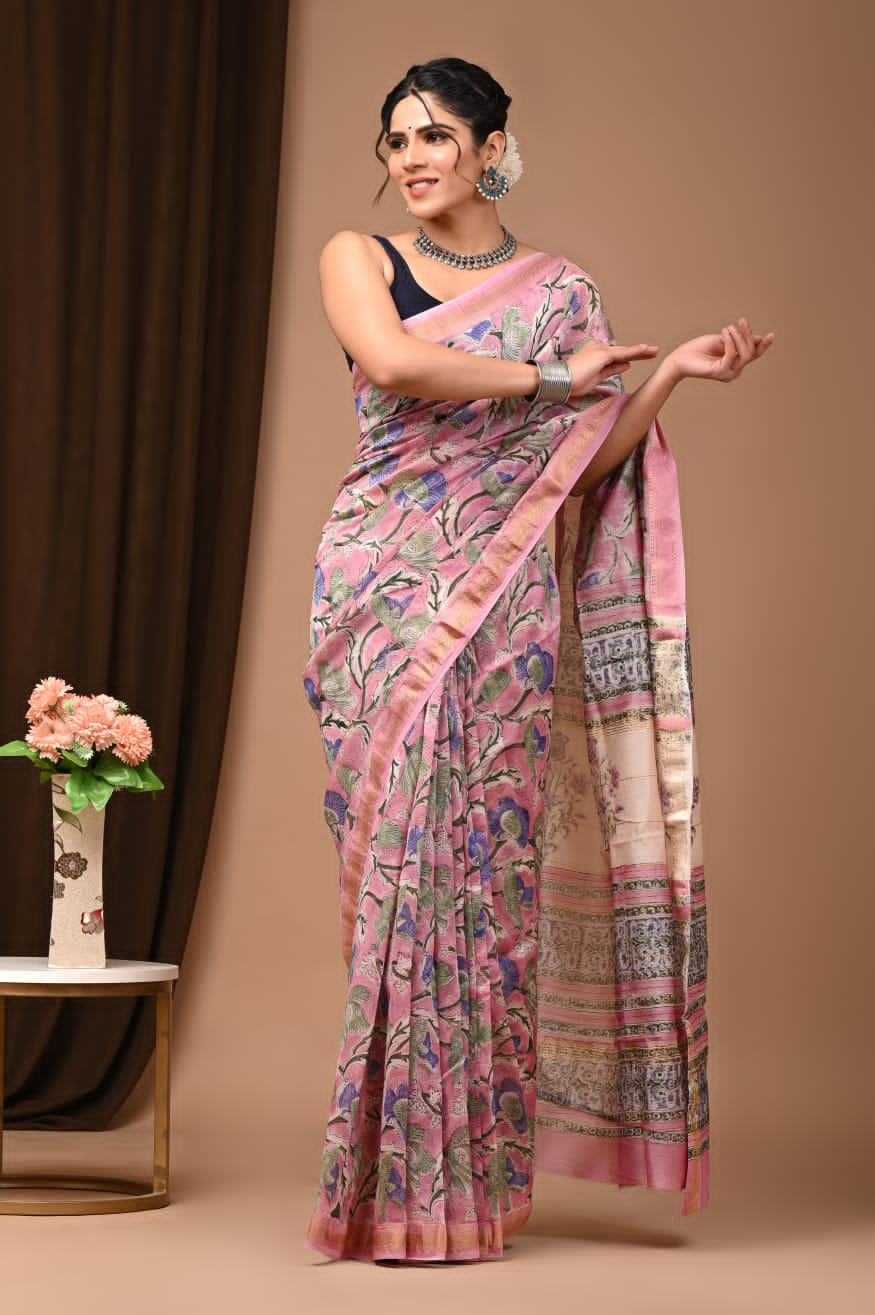
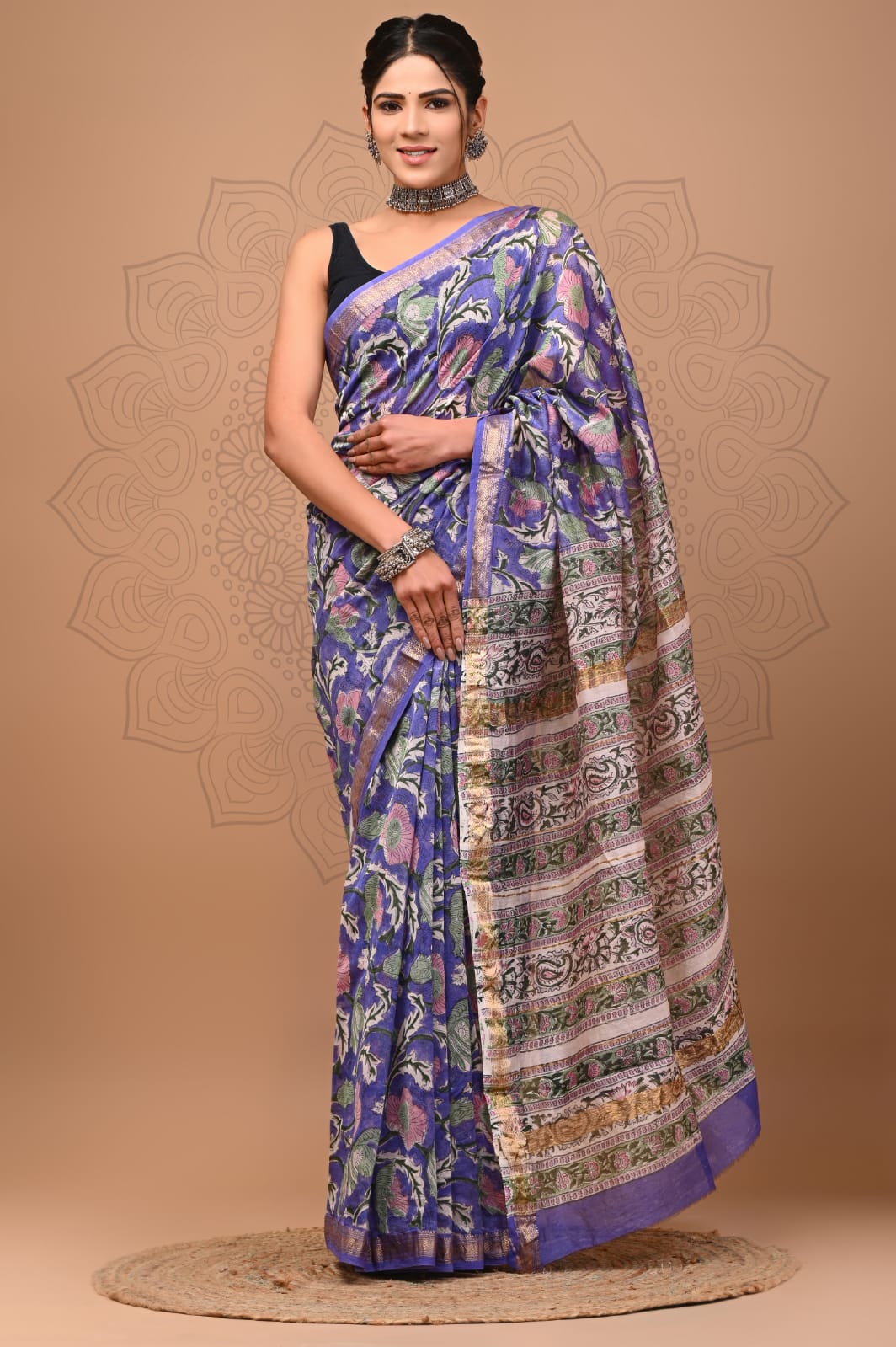
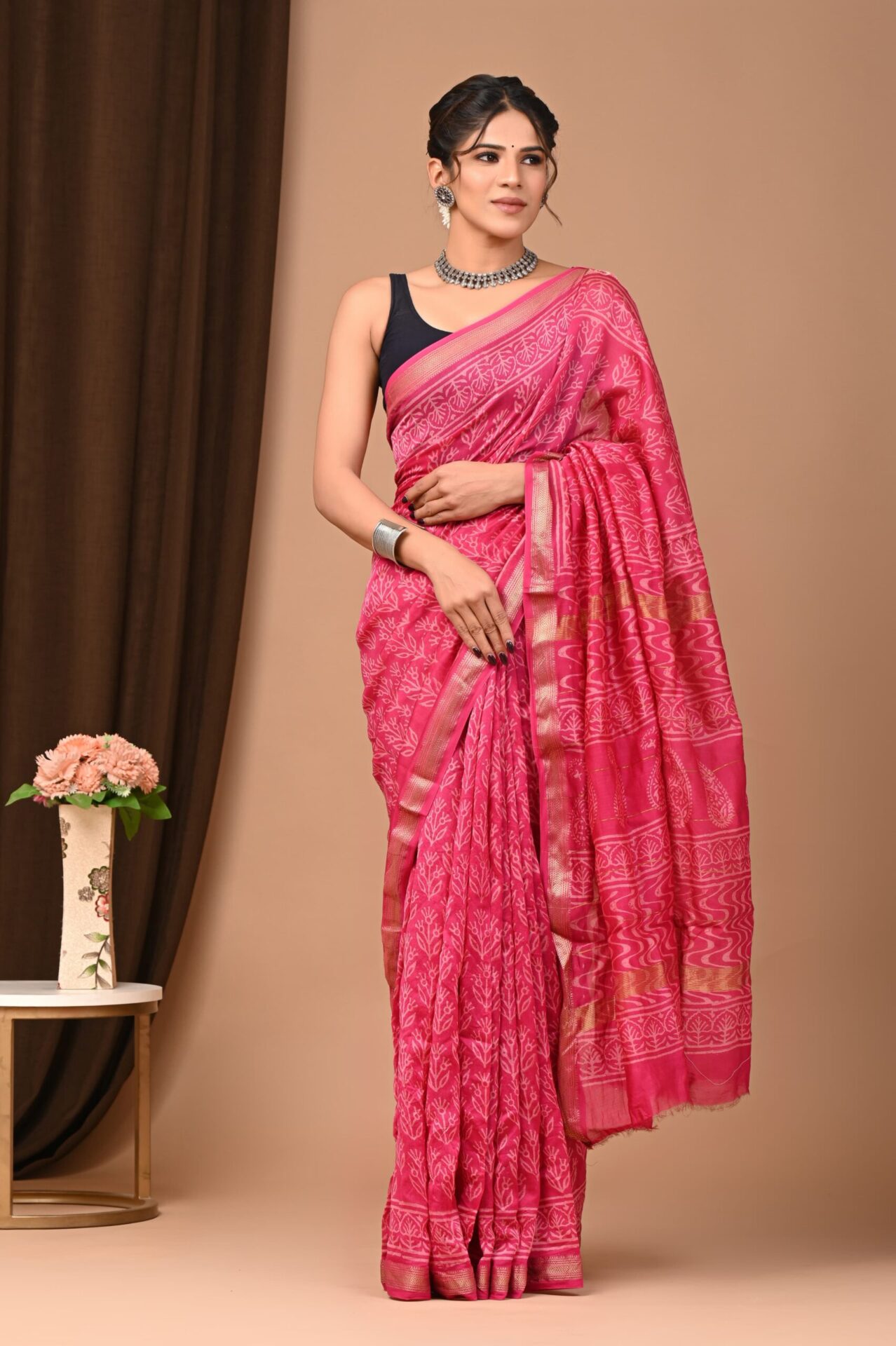
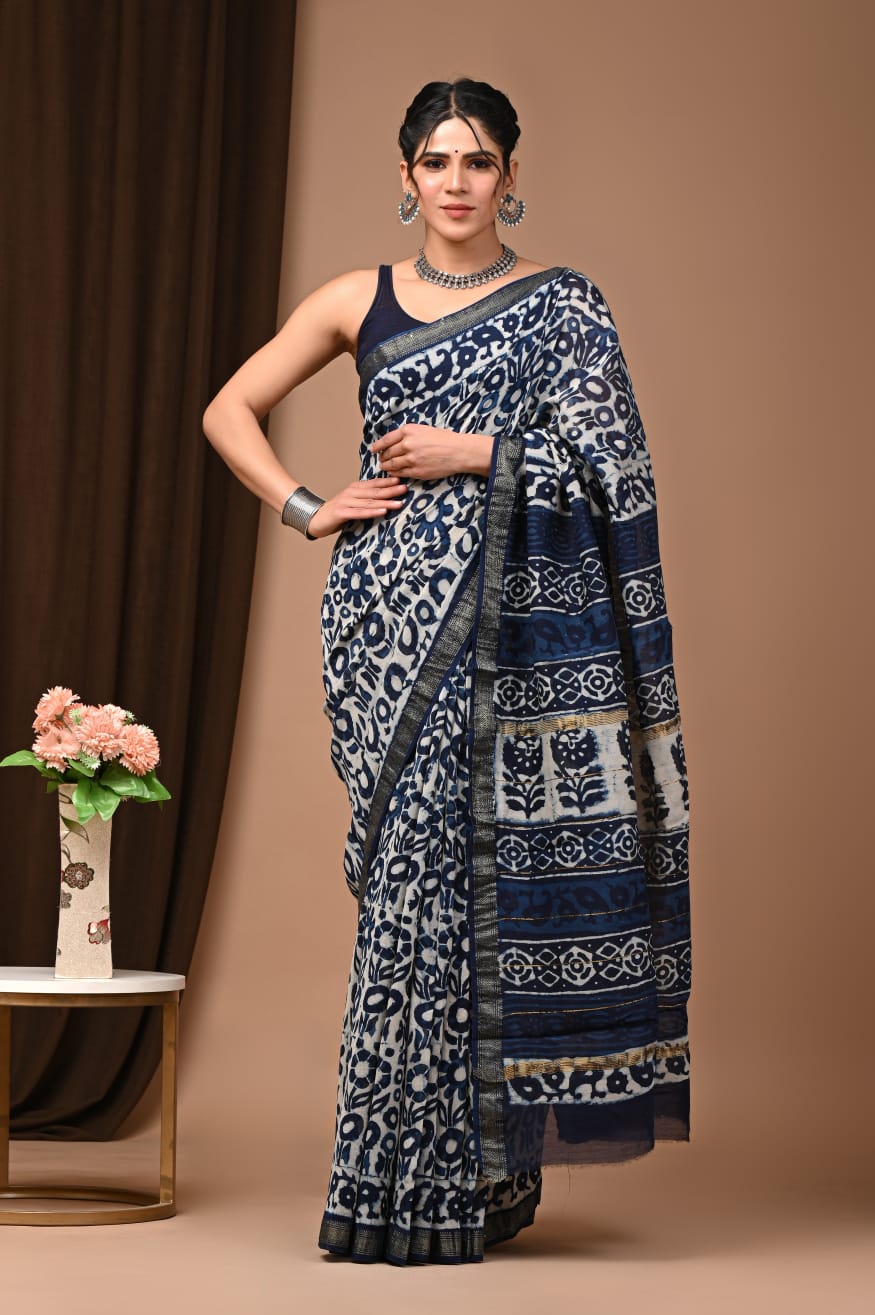
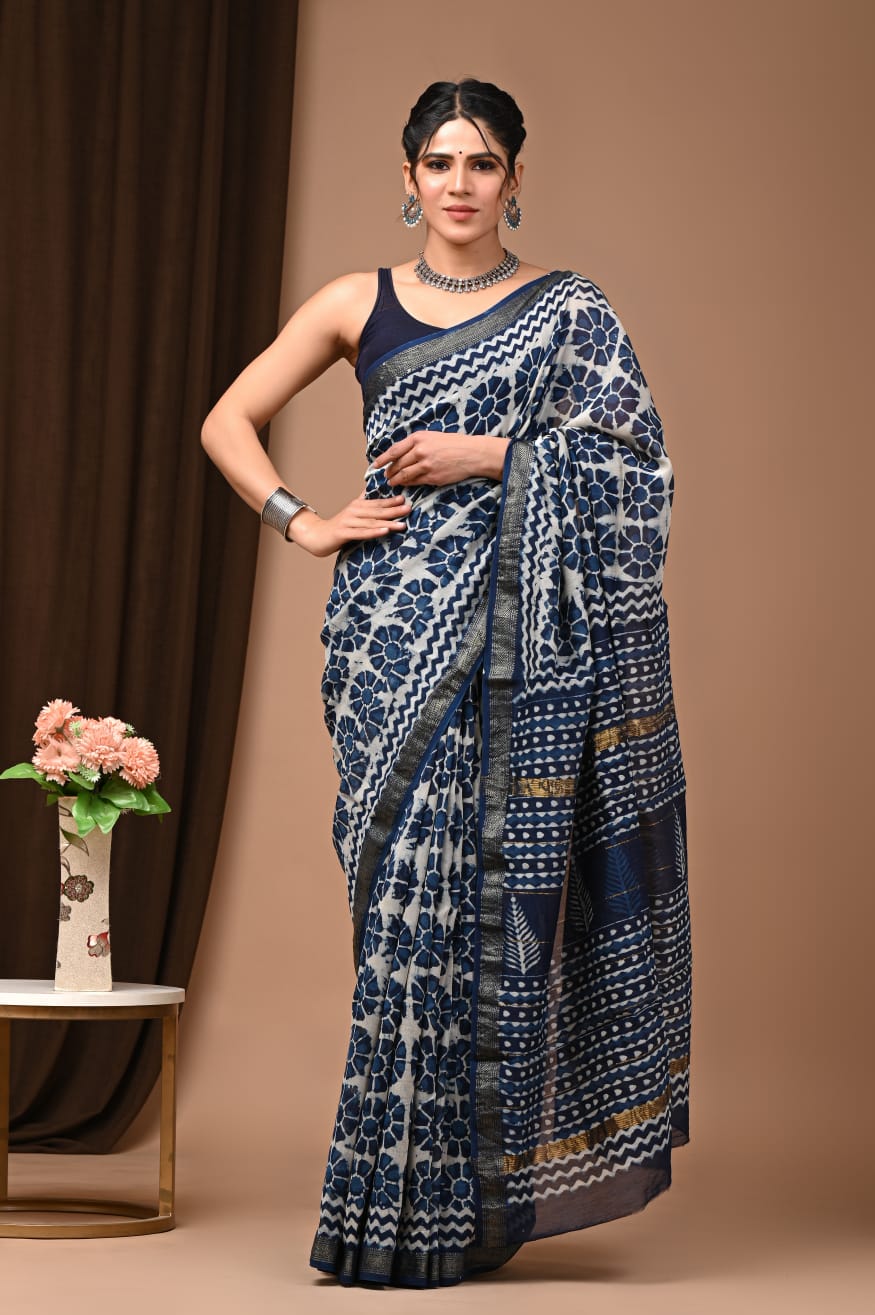
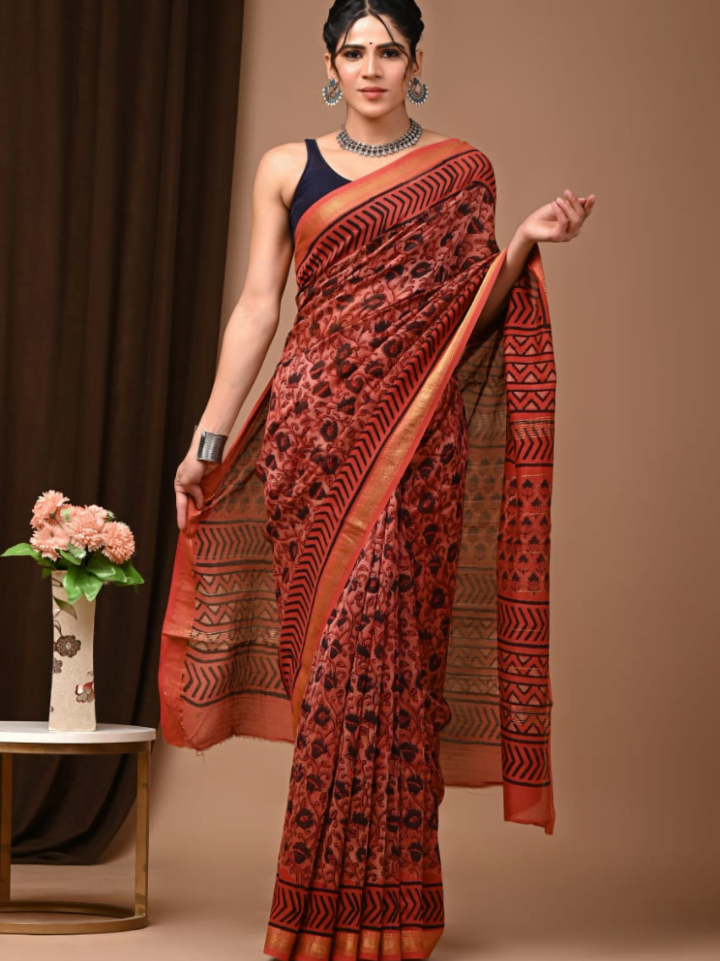
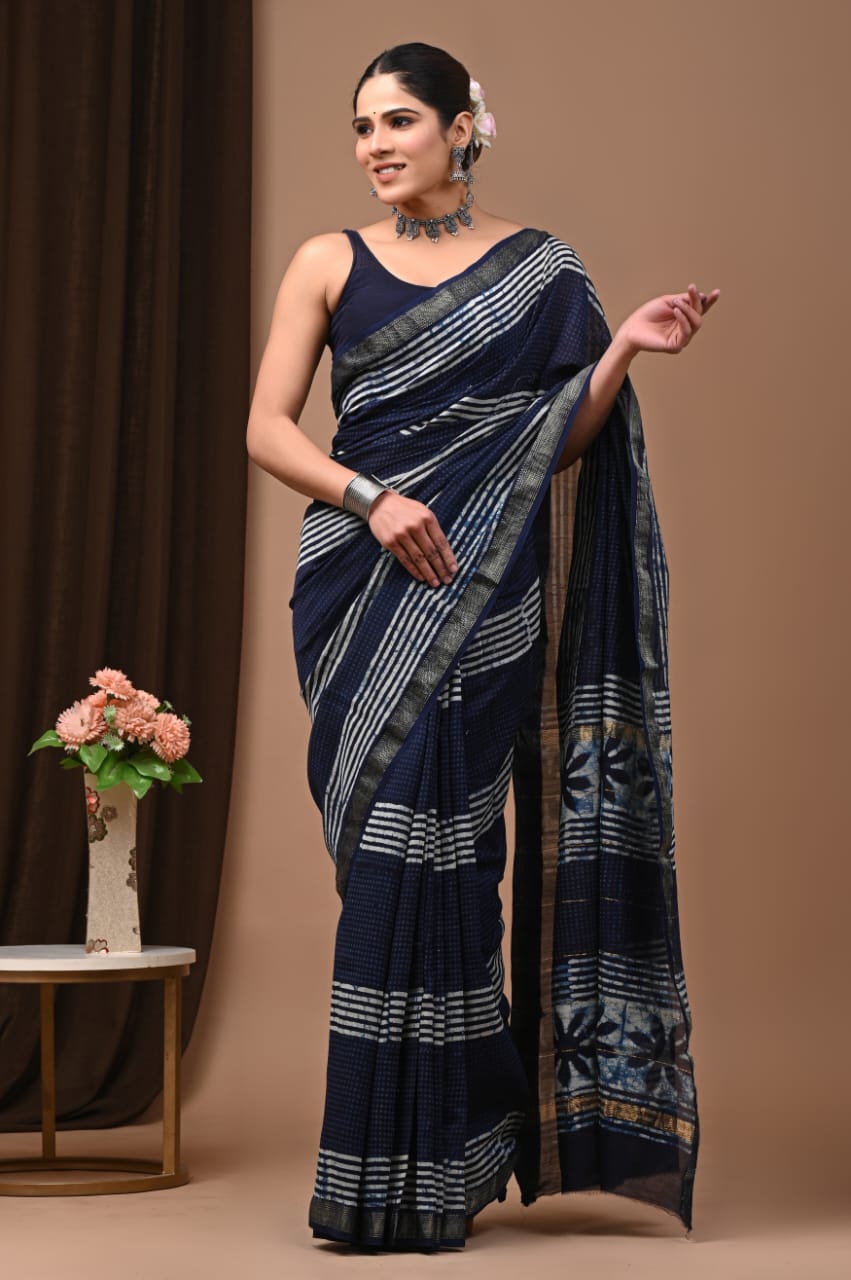
Our Bagru block print Maheshwari sarees carry the traditional Chhipa print vocabulary — dense floral trails, geometric motifs, and repeat patterns — stamped onto the Maheshwari silk-cotton base. The natural dye palette on Maheshwari fabric reads differently from cotton. Because the silk warp carries more dye depth than cotton weft, the natural dye colours have a subtle two-tone quality across the fabric surface. Our black block printed, indigo block printed, navy blue striped, pastel maroon zigzag, and pink block printed styles all use this Bagru print tradition on Maheshwari fabric.
Ajrakh Style Block Print Maheshwari Sarees
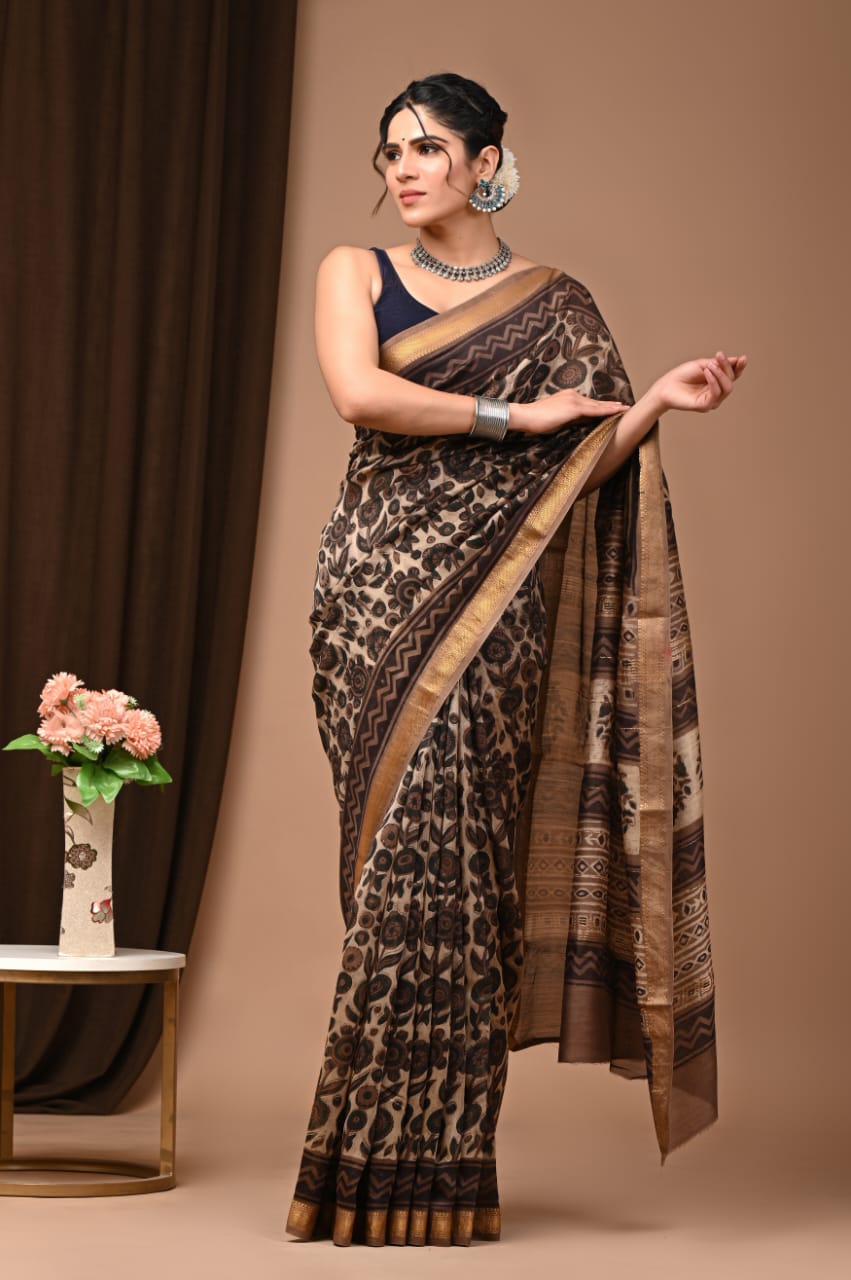
Four sarees in this collection carry an Ajrakh-inspired print on Maheshwari silk — a combination that is particularly distinctive. The geometric, resist-print vocabulary of Ajrakh — deep indigo and madder red patterns — reads with added depth on the Maheshwari silk warp. Our brown Ajrakh block printed, dusty pastel floral Ajrakh, mild red floral Ajrakh style, and transparent maroon Ajrakh style Maheshwari sarees are the richest visual pieces in the collection. They carry both the geometric authority of Ajrakh printing and the structural drape of Maheshwari silk — a combination that works strongly for weddings, receptions, and formal festive occasions.
Floral & Kalamkari Print Maheshwari Sarees
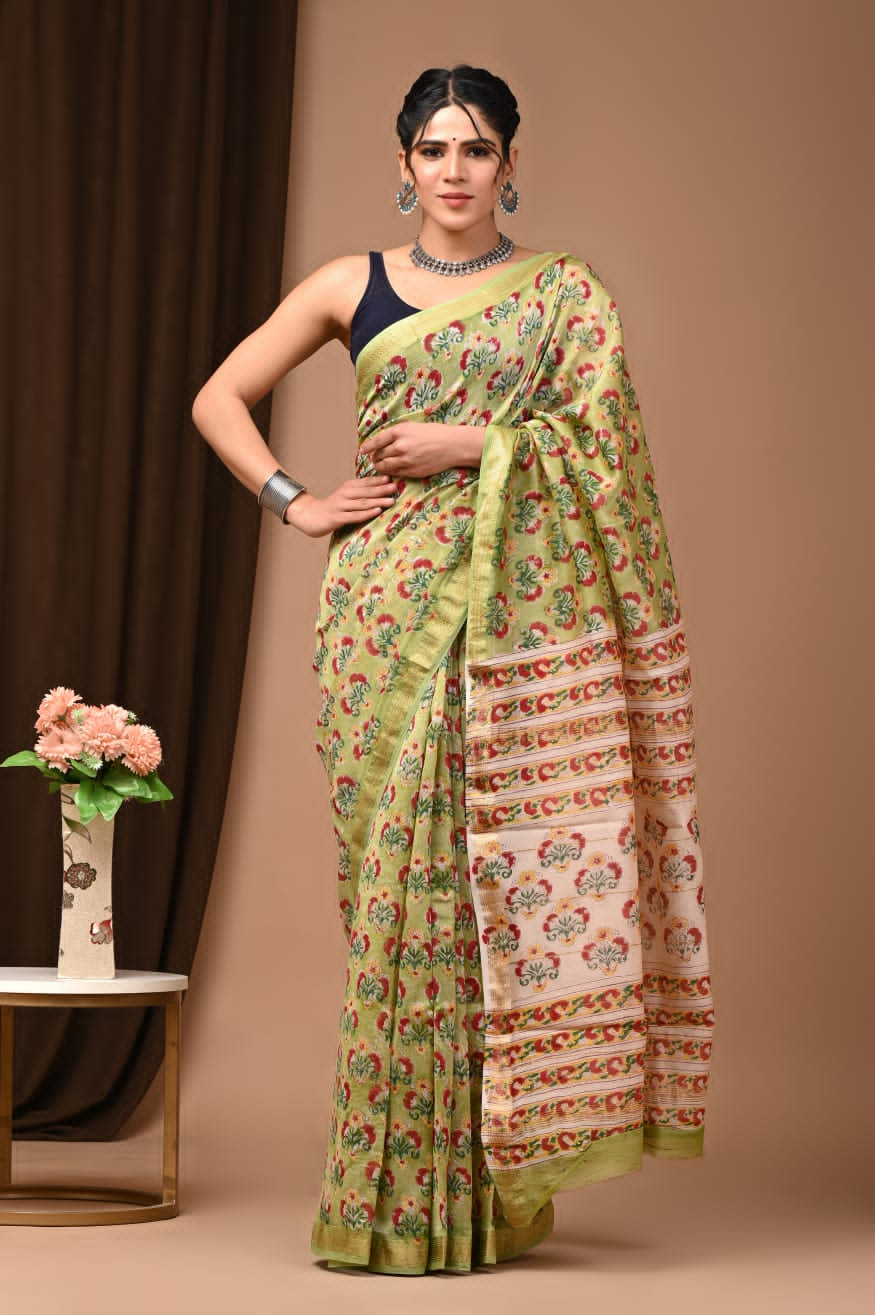
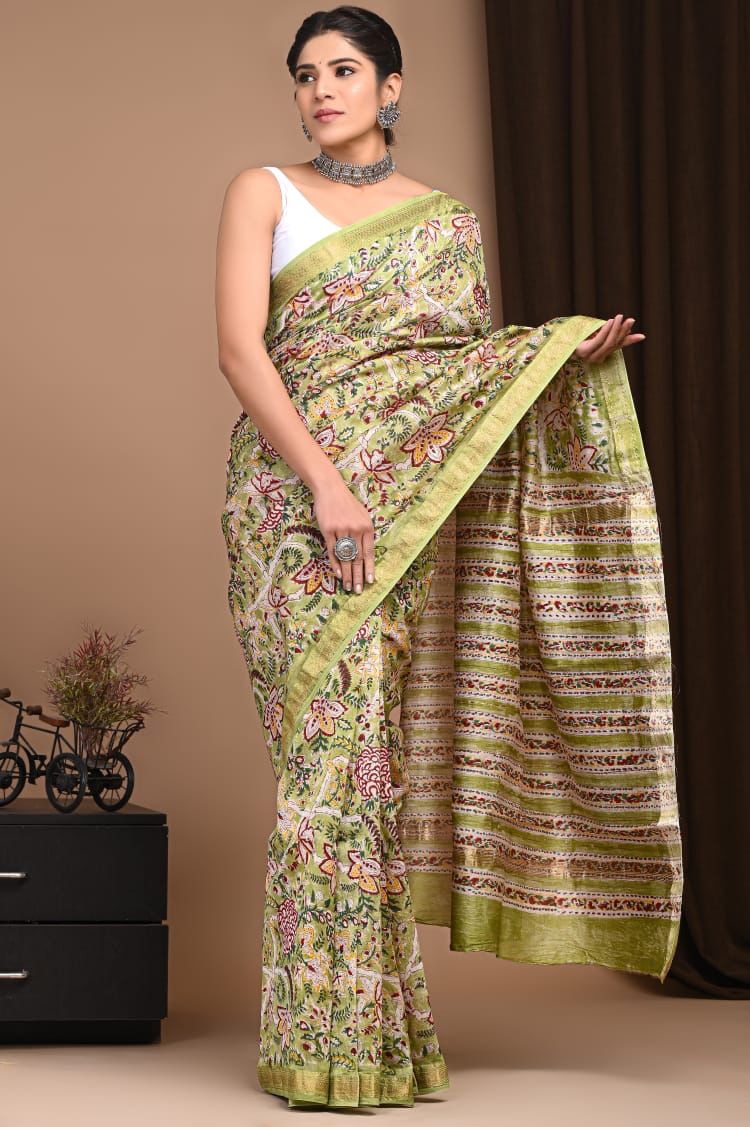
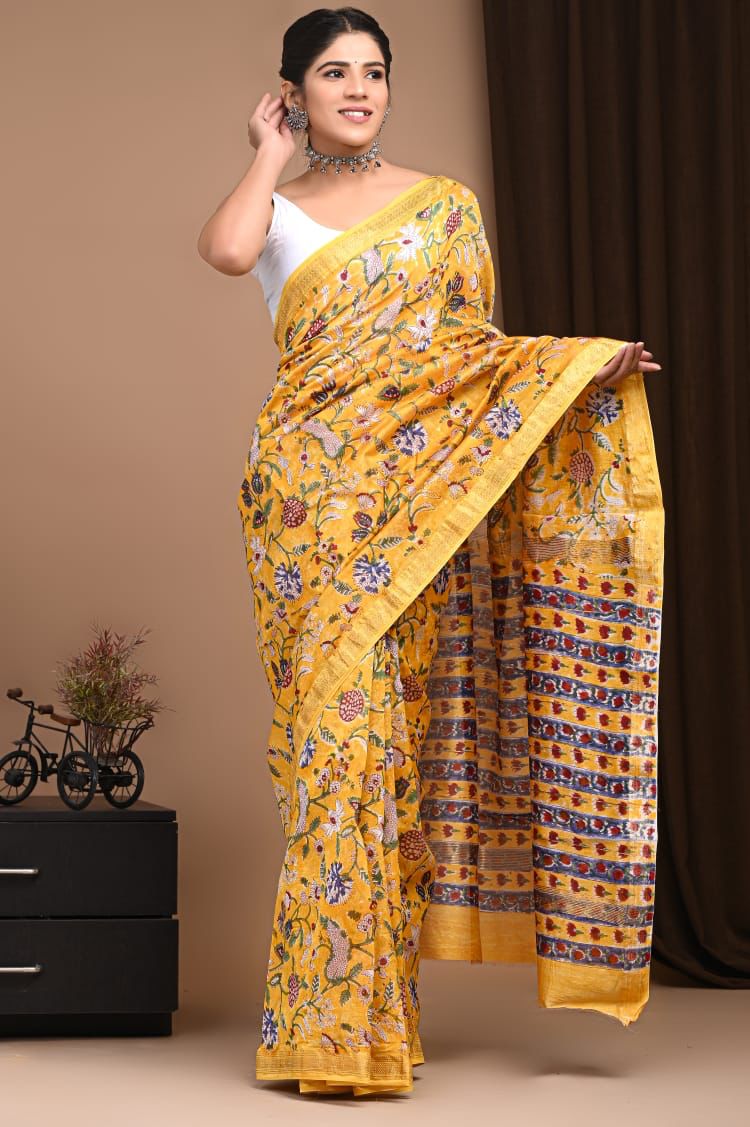
Our floral printed Maheshwari sarees — blossom pink, blue floral, golden floral, creamy yellow ochre, peach glow, soft pink, indigo floral — carry delicate botanical and floral motifs that complement the inherent softness of the Maheshwari fabric. The kalamkari style hot pink saree carries larger, bolder botanical motifs. These are the most versatile styles in the collection — they work across casual festive occasions, office wear, cultural events, and daily ethnic dressing.
Which Maheshwari Saree for Which Occasion
Office & Professional Wear
Maheshwari fabric is one of the best saree choices for office wear. It holds clean pleats, drapes crisply, and does not wrinkle throughout a full working day the way georgette or soft chiffon does. The structured silk-cotton weave stays composed under air conditioning and through long meetings. For office wear, our navy blue striped, indigo block printed, and black block printed styles carry the most professional register. Pair with a plain silk or cotton blouse in a solid complementary colour.
Festive & Occasion Wear
The natural sheen of the Maheshwari silk warp gives these sarees a subtle luminosity that reads as festive without being overtly formal. For Diwali, Navratri, and family celebrations, our deeper-tone styles — brown Ajrakh, transparent maroon Ajrakh, hot pink kalamkari — carry the festive register strongly. Since these sarees have a natural lustre rather than an applied finish, they also photograph well in both natural and artificial light without looking flat or over-shiny.
Weddings & Formal Functions
Our Ajrakh style Maheshwari sarees are the strongest choice for wedding functions. The combination of Maheshwari’s structured silk drape and the rich geometric Ajrakh print creates a saree that is visually complex without being heavily embellished. It suits wedding receptions, sangeet functions, and cultural events where you want a silk saree that carries craft authority rather than zari weight. Pair with a contrast blouse in a solid natural dye colour — cream, deep indigo, or madder red depending on the saree’s primary colour.
Daily Festive & Summer Wear
The cotton weft in Maheshwari fabric means it breathes more freely than pure silk. As a result, our lighter floral styles — blossom pink, soft pink, peach glow, golden floral — are genuinely comfortable for daily festive wear and outdoor summer occasions. They are lighter and cooler than most silk sarees while still carrying the structured drape and surface sheen that makes Maheshwari distinctive.
How to Drape and Style a Maheshwari Saree
Draping a Maheshwari Saree
Maheshwari fabric has a slight natural stiffness from the silk warp — more so than a cotton saree, less so than a heavily starched Kanjivaram. This stiffness is actually an advantage for draping. The pleats set firmly and hold their shape through the day without needing pins at every tuck. The pallu falls in a structured line rather than the fluid sweep of a softer silk. The Nivi drape is the most natural choice for Maheshwari — the structured pleats and clean pallu drape suit the fabric’s character well. For detailed step-by-step guidance on saree draping styles, visit our saree draping styles guide.
Blouse Pairing
A Maheshwari saree with a block print works best with a solid-colour blouse rather than a printed one — the block print on the saree body is already visually rich, and a plain blouse lets it lead. For Ajrakh print Maheshwari sarees, a deep indigo, madder red, or natural cream blouse creates the strongest contrast. For floral print styles, a blouse in any solid from the saree’s natural dye palette works — the Maheshwari fabric’s sheen will carry the combination well. For blouse design guidance, read our stylish blouse design guide.
Jewellery Guidance
The natural lustre of Maheshwari silk pairs best with silver jewellery — oxidised silver chokers, silver jhumkis, silver bangles. Gold jewellery also works well with the warmer-toned styles: the golden floral, creamy yellow ochre, and peach glow sarees carry gold well because the warm harda-dye ground tones in the print complement gold rather than competing with it. Avoid heavy stone-set jewellery with block print Maheshwari — the print provides sufficient visual complexity on its own.
Why SA Fab’s Block Printed Maheshwari Sarees Are Different
Most Maheshwari sarees sold online are either plain woven (no print) or digitally/screen printed after weaving. The plain versions depend entirely on the weave for visual interest. The digitally printed versions add a machine-applied pattern that sits on the fabric surface rather than interacting with the silk warp’s natural texture.
Our sarees are block printed by Chhipa artisans in Ganga Vihar, Bagru using natural dyes on the handwoven Maheshwari silk-cotton base. The block print motifs interact with the fabric’s existing texture — the dye penetrates the silk warp and cotton weft differently, creating a subtle tonal variation across the print that a flat digital print cannot replicate. Furthermore, because natural dyes are plant and mineral-based rather than synthetic, they do not change the hand feel of the Maheshwari fabric. The saree breathes and drapes exactly as the weaver intended.
We work directly with both communities — the Maheshwari weavers and the Chhipa printers — without factory intermediaries. Fair wages go to both sets of craftspeople. As a result, each saree in this collection carries two verifiable craft origins: Maheshwar, Madhya Pradesh for the weave, and Bagru, Rajasthan for the print.
How to Care for Your Maheshwari Saree
- First wash: dry clean recommended. For the first wash, dry cleaning preserves the silk warp’s structure and the natural dye’s initial setting. This is especially important for the Ajrakh style sarees where the resist-print process requires careful first-wash handling.
- Subsequent washes: gentle cold hand wash. After the first dry clean, gentle cold hand wash with a silk-safe mild detergent works well. Avoid rubbing the fabric — let it soak briefly and rinse gently.
- Never wring. The silk warp can distort if the saree is wrung out. Gently press excess water out between two clean towels instead.
- Dry in shade, flat if possible. Direct sunlight degrades both natural dye colours and silk fibre over time. Lay flat or hang gently in shade.
- Iron on low heat, on the reverse, with a pressing cloth. Maheshwari silk requires lower heat than cotton. Always iron on the reverse side through a pressing cloth to protect both the silk and the block print surface.
- Store in muslin, not plastic. Silk needs to breathe. Store folded in a muslin cloth, not in a sealed plastic bag, to prevent yellowing of the silk warp over time.
Frequently Asked Questions
What is a Maheshwari saree and what makes it different?
A Maheshwari saree is a handwoven fabric from Maheshwar, Madhya Pradesh — a weaving tradition established by Queen Ahilyabai Holkar in the 18th century. It uses silk yarn in the warp (lengthwise threads) and fine cotton yarn in the weft (crosswise threads), creating a fabric with the sheen of silk and the breathability of cotton. Three physical features identify an authentic Maheshwari: a reversible bugdi border, a five-stripe pallu, and a slight natural stiffness from the silk warp. For a full authenticity guide including the burn test, read our complete Maheshwari saree guide.
What is the difference between Maheshwari and Chanderi sarees?
Both originate from Madhya Pradesh and both use silk-cotton combinations, but they differ significantly in weave and drape. Chanderi uses an extra weft technique that creates motifs woven into the fabric, has a more fluid, sheer drape, and feels lighter in the hand. Maheshwari uses a plain weave with the characteristic reversible bugdi border, has a crisper, more structured drape, and holds pleats more firmly than Chanderi. In practical terms: Chanderi drapes more softly and is better for flowing or relaxed occasion wear. Maheshwari drapes more crisply and is better for office wear and occasions where clean pleats are important. Both are available in our saree collection — see our Chanderi sarees for comparison.
Are Maheshwari sarees suitable for summer?
Yes — and the silk-cotton combination makes them more summer-appropriate than many other silk sarees. The cotton weft running through the fabric allows more air circulation than a pure silk weave, so Maheshwari breathes better than Kanjivaram or Banarasi silk sarees. The structured drape also means the fabric does not cling against the body in heat the way georgette or chiffon does. Our lighter floral printed styles — peach glow, blossom pink, soft pink floral — are the most summer-appropriate in the collection because the lighter ground colours reflect heat rather than absorbing it.
What is an Ajrakh style Maheshwari saree?
Ajrakh is a resist-print block printing tradition from Kutch and Barmer — deep geometric patterns in indigo and madder red, built through a complex multi-step printing and dyeing process. An Ajrakh style Maheshwari saree combines this Ajrakh print vocabulary with the Maheshwari handwoven silk-cotton base. The result carries both the geometric depth of Ajrakh printing and the structured silk drape of Maheshwari fabric. In our collection, four sarees carry Ajrakh-inspired prints — the brown Ajrakh, dusty pastel floral Ajrakh, mild red floral Ajrakh style, and transparent maroon Ajrakh style. For a full explanation of the Ajrakh tradition and how it differs from Dabu printing, read our Ajrakh vs Dabu article.
How do I care for a block printed Maheshwari silk saree?
Dry clean for the first wash — this protects both the silk warp structure and the natural dye’s initial setting. For subsequent washes, a gentle cold hand wash with silk-safe mild detergent works well. Never wring the saree — press excess water out gently between clean towels. Dry flat or hanging in shade — never in direct sunlight, which degrades both natural dyes and silk fibre. Iron on low heat on the reverse side through a pressing cloth. Store folded in muslin rather than plastic to allow the silk to breathe between wears.
Explore More Sarees from SA Fab
If you are building a complete saree wardrobe, these categories complement our Maheshwari collection:
- Chanderi Sarees — a softer, more fluid silk-cotton blend from Chanderi, MP. The natural comparison fabric to Maheshwari.
- Modal Silk Sarees — for occasions where you want the softness and drape of silk with a more affordable, sustainable fibre.
- Pure Linen Sarees — the most breathable option for extreme summers. A very different drape from Maheshwari but the right choice for outdoor summer occasions.
- Kota Doria Sarees — fine cotton-silk weave from Kota, Rajasthan. Lighter and sheerer than Maheshwari, with a characteristic square-grid texture.
- Cotton Sarees — pure cotton block printed sarees for the most affordable and breathable option in our saree collection.
- Maheshwari Suit Sets — the same handwoven Maheshwari fabric in a salwar suit silhouette for a less formal ethnic occasion.
Free Shipping · 7-Day Returns · Directly from Bagru
Every Maheshwari saree ships free across India. Worldwide delivery is also available. If the colour or size of the blouse piece is not right, our 7-day easy exchange policy makes it simple to resolve. We accept UPI, Visa, Mastercard, RuPay, and net banking.
For help choosing the right Maheshwari saree for your occasion, skin tone, or blouse pairing — WhatsApp us between Monday and Saturday, 10am to 7pm IST. We know this collection well and will guide you straight to the right piece.