
In This Guide
What Is Hand Block Print?
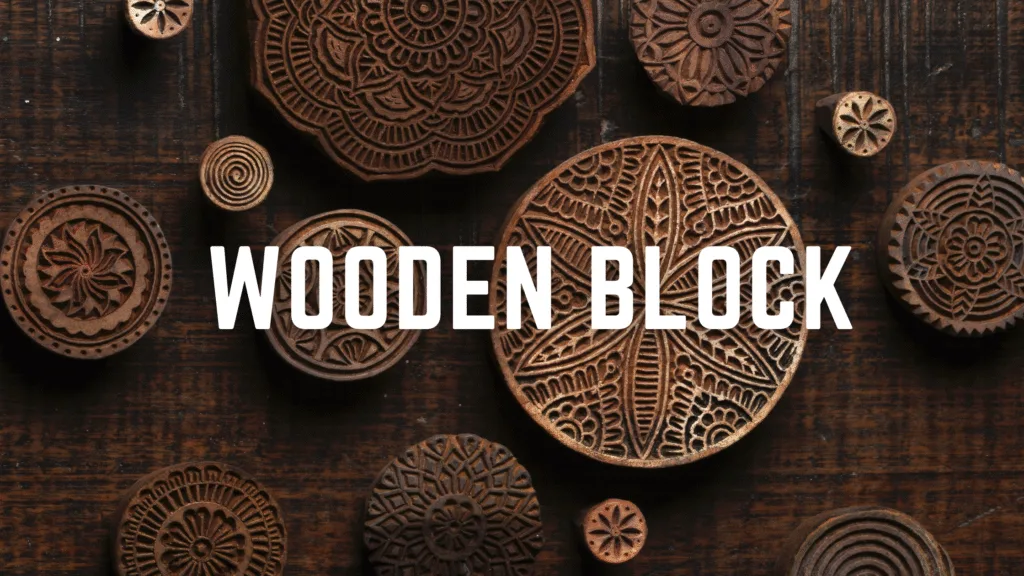
Hand block print is a textile printing technique in which a hand-carved wooden block is dipped into dye or ink and pressed onto fabric by hand, one impression at a time, to build up a repeating pattern. Every motif on the cloth is a direct result of a person pressing a physical object against it — there is no screen, no roller, no digital file involved. Just wood, dye, cotton, and a practised hand.
It is one of the oldest forms of textile decoration still practised at scale. Archaeological evidence places woodblock printing on textiles in parts of South Asia and China over a thousand years ago. In Rajasthan specifically, the tradition is documented continuously for over 450 years, with the craft concentrated primarily in two villages near Jaipur: Bagru and Sanganer.
What distinguishes hand block print from modern alternatives — screen printing, rotary printing, digital textile printing — is not the visual result alone but the physical reality of how it's made. A block must be carved by hand. Each impression must be pressed manually. The repeat pattern, no matter how skilled the printer, carries small human variations across an entire length of cloth. These are not imperfections. They are evidence.
How Hand Block Print Is Made: The 12-Step Process
Most people picture only the stamping moment — block meets fabric. The stamping is roughly step seven of twelve. Here is the full sequence as practised in Bagru:
If you want the deeper story behind each step — including the chemistry of why madder root produces red and why indigo needs an alkaline vat — our full guide to the art of hand block printing covers it in detail.
What Makes Bagru Print Unique
Bagru print is a specific regional variant of hand block print practised in Bagru village, roughly 32 kilometres from Jaipur. The Chhipa community has been printing here for over 450 years, and the craft carries Geographical Indication status under Indian law — registered in 2011 — which legally distinguishes genuine Bagru-origin prints from imitations produced elsewhere.
Three things make Bagru print visually and technically distinct from other Indian block printing traditions. First, the characteristic off-white or cream base produced by the harda seed treatment in step three — Bagru prints have an inherently warm, earthy base tone that comes from the chemistry of the preparation, not from a dye. Second, the dominant use of natural dyes in deep, muted earth tones: madder root reds, indigo blues, iron blacks, and harda-derived yellows. Third, the Dabu mud-resist technique, which is primarily a Bagru speciality and creates the soft-edged, slightly blurred resist patterns the craft is known for.
The local water at Bagru also plays a role that's not metaphor — it's material reality. The mineral composition of water drawn from Bagru's sources affects how natural dyes interact with cotton during the washing stages, contributing to the specific depth and warmth of tone that characterises genuine Bagru-printed fabric and distinguishes it from the same dye used elsewhere.
"The water at Bagru is not incidental to the craft. It is part of the recipe. The same block, the same dye, the same artisan produces a different result in different water. That is why you cannot move Bagru printing to a factory in another city and call it the same thing."
Bagru Print vs Sanganeri vs Ajrakh — What's the Difference?
These three are the most commonly confused regional block printing traditions in India, and the confusion is understandable because all three use hand-carved wooden blocks and 100% traditional dye processes. The differences are in technique, origin, motif language, and colour palette.
| Feature | Bagru Print | Sanganeri Print | Ajrakh Print |
|---|---|---|---|
| Origin | Bagru, Jaipur (Rajasthan) | Sanganer, Jaipur (Rajasthan) | Kutch (Gujarat) + Barmer (Rajasthan) |
| Community | Chhipa artisans | Chhipa + Raigar artisans | Khatri artisans |
| Base colour | Off-white / warm cream (harda) | Bright white | Deep indigo or black |
| Motifs | Floral, organic, earthy | Fine floral, delicate, light | Geometric, bold, symmetric |
| Signature technique | Dabu mud resist | Direct dye block print on white | Double-sided resist and dye (up to 16 steps) |
| GI Status | Registered 2011 | Registered 2010 | GI-protected in respective regions |
For a deeper breakdown of how Ajrakh and Dabu printing differ from each other specifically — including how to identify each by sight — our dedicated comparison guide covers both traditions in full.
Which Fabrics Work Best for Hand Block Printing
Natural fibres absorb natural dyes better than synthetic ones, which is why the vast majority of genuine hand block print is done on pure cotton, linen, silk, or silk-cotton blends. Each behaves differently under the block and in the dye vat.
Pure cotton is the most common base for Bagru printing. It absorbs natural dye deeply, breathes well in the finished garment, and is the fabric most forgiving of the multi-step wet processes involved. Our hand block printed cotton sarees and cotton suit sets use pure cotton throughout.
Linen takes natural dye well and produces a slightly crisper hand than cotton, with a texture that shows block print motifs cleanly. Hand block printed linen sarees are particularly popular for summer wear.
Modal silk and Chanderi are finer weaves that carry block print with a more luxurious drape. The print sits differently on these — the motif appears softer, less graphic, with the sheen of the weave carrying through the dye. Both work well for festive and occasion wear.
Kota Doria is the most technical fabric to print on — its open, checked weave requires careful block placement to ensure the motif registers evenly across the transparent sections. When done well, it's one of the most striking results in hand block printing.
How to Tell Genuine Hand Block Print from Machine Print
As demand for hand block print has grown, so has the volume of digitally or rotationally printed fabric sold under the same name. Here are the four fastest checks:
1. Check the back. Genuine hand block print lets dye penetrate through the weave. Turn the fabric over — you'll see a faint ghost of the pattern on the reverse. Machine prints stay on the surface, leaving the back mostly white.
2. Check the repeat. Look at where one block impression meets the next. A genuine hand printer aligns by eye using small registration marks — the repeat shifts very slightly, consistently, across the cloth. A machine print repeats with mathematical perfection.
3. Smell the fabric. Natural dye processes carry an earthy, organic smell — wet clay, fermented indigo, plant material. Synthetic dye fabric smells like nothing, or faintly chemical.
4. Ask the origin question. Ask where specifically the fabric was printed. A genuine source names the village. A reseller hiding a factory print stays vague.
For the full five-point guide including what to ask and how to test feel and texture, see our complete guide to spotting fake handblock prints.
Bagru Hand Block Print Manufacturers: What to Know Before You Source
Bagru has a large number of family-run printing units operating at different scales, from single artisan workshops to mid-size production units supplying wholesale. If you're sourcing fabric or finished pieces from Bagru manufacturers directly — for a boutique, a fashion label, or personal bulk buying — a few things are worth knowing.
Most genuine Bagru manufacturers don't have a strong online presence. The artisan families who've been doing this the longest tend to sell through relationships, local agents, or a small number of DTC brands that source directly from them. IndiaMART listings for "hand block print fabric Bagru" include genuine manufacturers but also resellers, so the verification checks above apply here as much as in retail.
GI certification matters for sourcing. Bagru Hand Block Print carries a 2011 Geographical Indication registration. If you need documented proof of origin for retail labelling, export, or brand claims, ask your manufacturer for GI-compliant documentation from an authorised Bagru producer association.
Minimum orders vary widely. Large wholesale units in Bagru typically require 50-metre minimums per design. Artisan-direct DTC brands — like SA Fab — often offer fabric in 10-metre rolls with no minimum, which is the practical route for smaller buyers, boutiques, or designers wanting to test a style before scaling up.
Where to Buy the Best Block Print — What "Best" Actually Means
The best block print store is the one closest to the source — literally. Every step between the printing workshop and you adds cost, reduces traceability, and increases the chance of mislabelling. A DTC brand sourcing directly from Bagru artisans without a wholesale or retail layer in between gives you more of the actual craft value for the same money.
At SA Fab, we work directly with Chhipa community artisans in Ganga Vihar, Bagru — which is the same neighbourhood where the craft has been practised for centuries, not a fulfilment centre elsewhere. Our Dabu print fabric and Ajrakh print fabric are both available in 10-metre rolls with free shipping across India and worldwide delivery, with no minimum order for retail buyers.
For finished garments, our full range covers cotton sarees, cotton suit sets, kurtis, men's block printed shirts, and home furnishing — all hand block printed in Bagru, all completely synthetic azo-free, all with 7-day returns if anything doesn't meet expectations when it arrives.
Fabric
Ajrakh & Dabu
10m rolls · No minimum
Women's
Cotton Sarees
From ₹949 · Free shipping
Women's
Cotton Suit Sets
From ₹1,199 · 7-day returns
Men's
Block Print Shirts
Direct from Bagru artisans
Frequently Asked Questions
What is hand block print and how is it different from screen printing?
How old is Bagru hand block printing?
What dyes are used in Bagru hand block printing?
Where can I buy genuine Bagru hand block print fabric or clothing?
What is the minimum order for Bagru block print fabric?
Free shipping across India · Worldwide delivery available · 7-day easy returns and exchange
Sourcing queries welcome: WhatsApp us — Monday to Saturday, 10am to 7pm IST.
Buy Hand Block Print Direct from Bagru
No middlemen. Traditional dyes. Chhipa artisans. Free shipping across India.
Shop Fabric Shop Women's Collection