
Bharat Tex 2026:
The Complete Visitor's Guide
Dates, registration, what to expect — and a sourcing route that works even if you can't make the trip to Delhi this July.
If you're a fashion buyer, boutique owner, or textile sourcing professional, Bharat Tex 2026 is the one fixture worth blocking out on your July calendar. Organised by the Consortium of Textile Export Promotion Councils with backing from India's Ministry of Textiles, this is the third edition of what's already being described as one of the youngest and largest textile trade shows in the world.
Whether you're flying in from Europe to source sustainable fabric or driving up from Mumbai to meet weaving clusters in person, here's what you actually need to know to make the trip count.
Essential Details at a Glance
Dates: 14–17 July 2026 (Tuesday to Friday)
Venue: Bharat Mandapam, Pragati Maidan, New Delhi
Organisers: Consortium of Textile Export Promotion Councils, supported by the Ministry of Textiles, Govt. of India
Scope: The full textile value chain under one roof — apparel, home furnishings, fibres and yarns, handloom and handicrafts, technical textiles, and sustainability-focused pavilions.
How to Get Your
Visitor Pass
Registration opens well ahead of the event, and going in without a confirmed pass usually means longer queues on the day. Domestic visitors can register through the official Bharat Tex website, and it helps to carry a business card along with GST details if you're applying for a B2B trade pass rather than a general visitor pass.
International buyers have a slightly different path. The organisers run a Hosted Overseas Buyer Program specifically for foreign delegates, and it's worth checking with your local Indian embassy or trade office, or directly with the relevant Export Promotion Council, to see if you qualify for sponsored travel or facilitated entry. Buyer programs like this tend to fill up faster than general registration, so the earlier you apply, the better your odds.
What to Expect Inside
Bharat Mandapam
Bharat Tex covers the textile value chain end to end, often described by organisers as "farm to fashion." Given the scale, it helps to prioritise before you arrive rather than wander the halls reactively.
Innovation & Machinery
If your interest is manufacturing rather than buying finished goods, this is where automated looms, digital printing technology, and sustainable dyeing machinery get demonstrated live.
Global Sourcing Pavilion
This is where large-scale garment manufacturers set up for bulk international orders — readymade garments, home textiles, and technical textiles aimed squarely at high-volume B2B buyers.
Heritage & Handloom Pavilion
For many visitors, this is the real reason to attend. Independent weavers, artisan clusters, and craft collectives showcase techniques that go back centuries — Chanderi weaving, Banarasi silk, and Rajasthani hand block printing among them.
A Note for Serious Buyers
"If you're heading to the Heritage & Handloom Pavilion to source authentic fabric like Ajrakh or Bagru prints, go in with your eyes open. A genuine piece and a convincing factory-made rotary print can look identical from two feet away — the difference only shows up once you actually handle the cloth."
Three Quick Tests Before
You Place a Bulk Order
None of these take more than a few seconds, and all three are worth doing before you commit to a bulk order at the expo, not after the shipment arrives back home.
- Check the reverse side: Genuine hand block printing lets dye bleed through to the back of the fabric. Machine and rotary prints sit only on the surface, leaving the reverse side close to white.
- Smell the fabric: Real natural dyes like indigo and madder carry an earthy smell, close to wet soil. Synthetic dye on a machine print usually smells like nothing at all, or faintly chemical.
- Look for imperfection, not precision: A pattern that repeats with mathematical exactness across the whole bolt is a strong sign of machine production. A human hand pressing a carved block leaves small, natural shifts in alignment.
We've written a fuller breakdown covering five separate tests in our complete guide to spotting fake handblock prints — worth a read before you're standing at a stall with a sourcing decision to make on the spot.
Can't Make It to
New Delhi This Year?
Not every buyer, boutique owner, or designer who wants genuine Indian handcraft textile can clear four days in July for a trip to Delhi — visa timelines, travel budgets, and clashing calendars are all real constraints. The good news is that attending in person has never been the only route to sourcing authentic fabric from a craft cluster like Bagru.
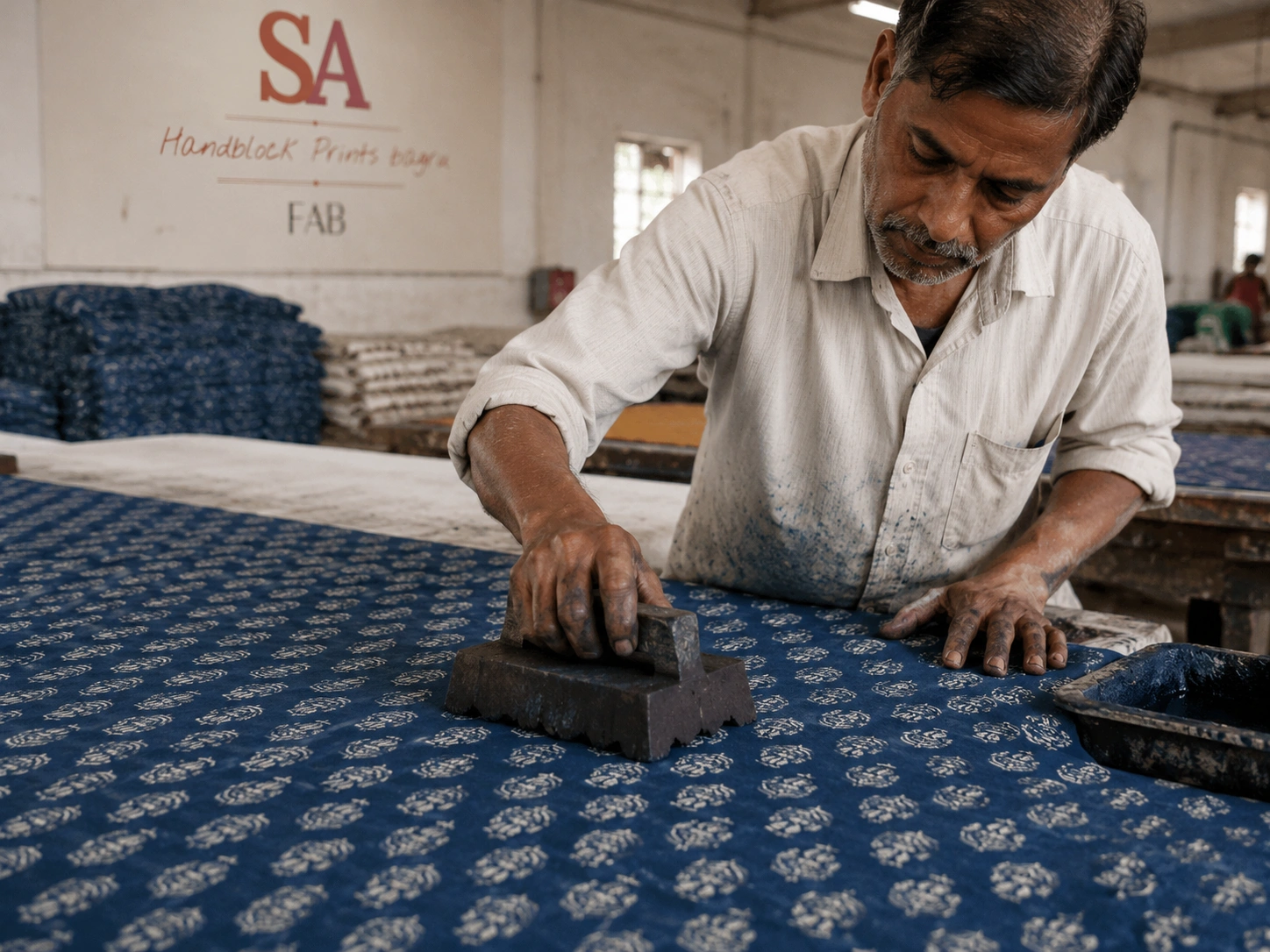
At SA Fab, we work directly out of Ganga Vihar, Bagru — one of the villages the Heritage & Handloom Pavilion exists to represent — with Chhipa community artisans who hand print using carved wooden blocks and natural dyes. There's no factory step in between, no reseller markup, and no guessing whether what arrives at your door passes the same tests we just walked through. It either does or it doesn't, and we'd rather you check than take our word for it.
If your sourcing list this season includes mud-resist Dabu prints, our Dabu print fabric ships in 10-metre rolls with no minimum order, so a boutique can test a small run before committing to volume. For ready-to-wear pieces rather than yardage, our Chanderi sarees carry the same hand block printing on a finer weave, and we ship internationally with the same craft documentation you'd want for retail or wholesale sourcing.
Bharat Tex is worth attending if you can. But if you can't, the actual craft the Heritage Pavilion is built to showcase is reachable directly, fabric in hand, without needing a flight to Delhi at all.
Frequently Asked Questions
Where is Bharat Tex 2026?
How to register for Bharat Tex 2026?
Where is the upcoming garment fair in India 2026?
What is the Bharat exhibition 2026?
How do I know if hand block print fabric at the expo is genuine?
Can I source authentic Bagru hand block print fabric without attending Bharat Tex?
The Craft Bharat Tex Showcases, Available Year-Round
No flight to Delhi required. Genuine hand block printed fabric and clothing from Bagru, shipped directly from the artisans who made it.
Free shipping across India · Worldwide delivery available · 7-day easy returns and exchange
Questions about sourcing in bulk for your boutique or store? WhatsApp us — Monday to Saturday, 10am to 7pm IST.