
How to Spot Fake
Handblock Prints
Five honest tests — taught by an artisan's daughter — to tell a genuine Bagru hand block print from a soulless factory copy before you spend a single rupee.
A flawless print isn't a sign of quality. In handblock printing, it's usually the opposite — proof that no human hand ever touched the cloth.
Thwack. Thwack. Thwack. That sound is the actual heartbeat of Bagru. I still remember standing in our workshop in Rajasthan for the first time, the air thick with the sharp, fermented smell of natural indigo, my hands brushing rough, sun-baked cotton drying flat on the hot earth. At SA Fab, we don't just sell clothes. We keep a dying craft alive. But the market right now is drowning in cheap, machine-printed knockoffs sold as "handblock," and it drives me crazy. People pay good money for soulless fakes. Let me show you exactly how to tell the real thing from the garbage.
Why This Question Keeps
Coming Up
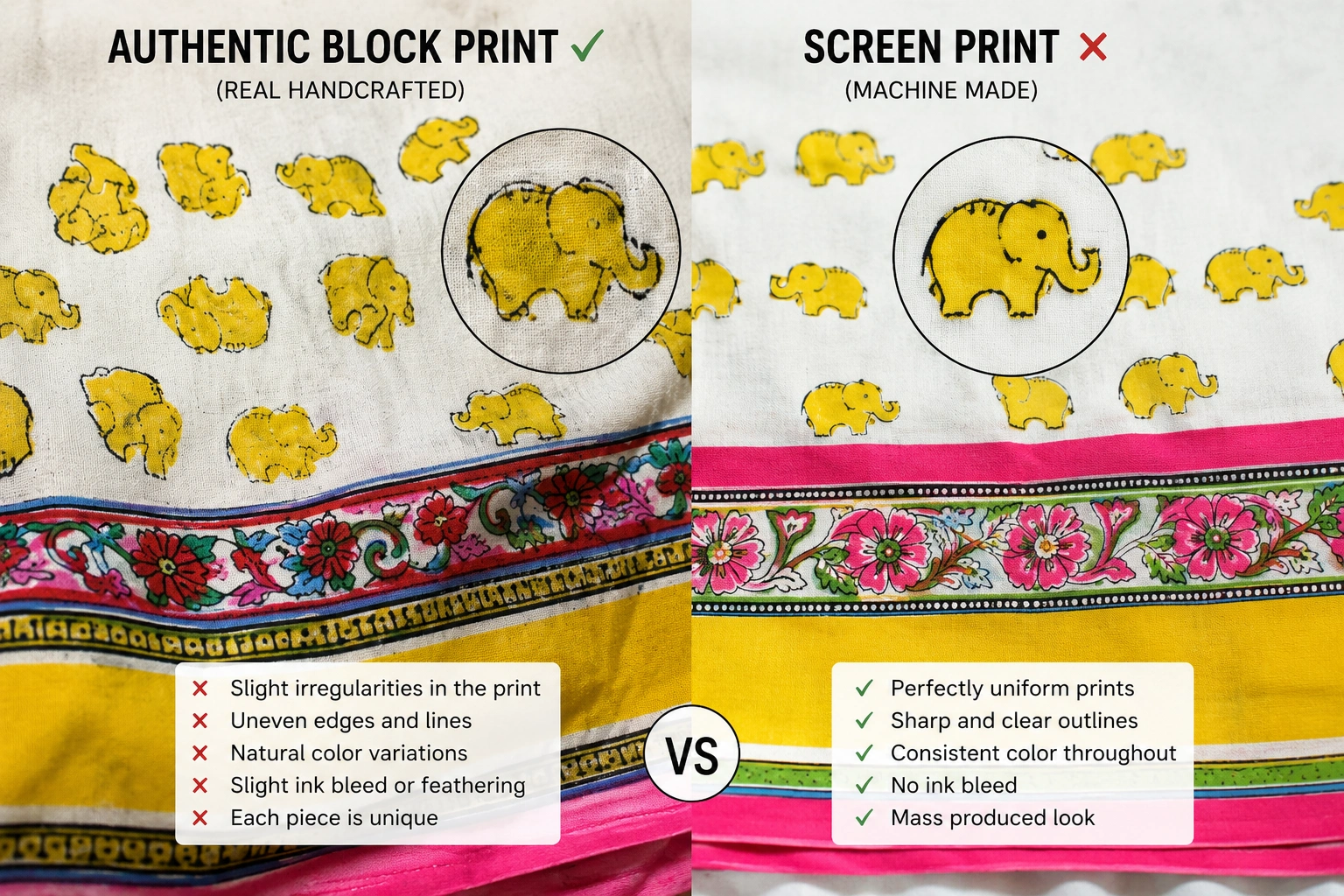
Search any forum for handblock print and you'll find the same question asked a hundred different ways. How do I know if this saree is actually hand printed? Is this Ajrakh real or digital? My kurta looks too perfect, did I get scammed? People are asking because the fakes have gotten good. A skilled factory can now run a digital print that mimics a block motif closely enough to fool a quick glance.
But a quick glance is exactly the problem. Real handblock printing leaves evidence everywhere — in the imperfections, the smell, the back of the fabric, even in how it feels under your fingertips. You just have to know where to look.
Five Tests Before
You Buy
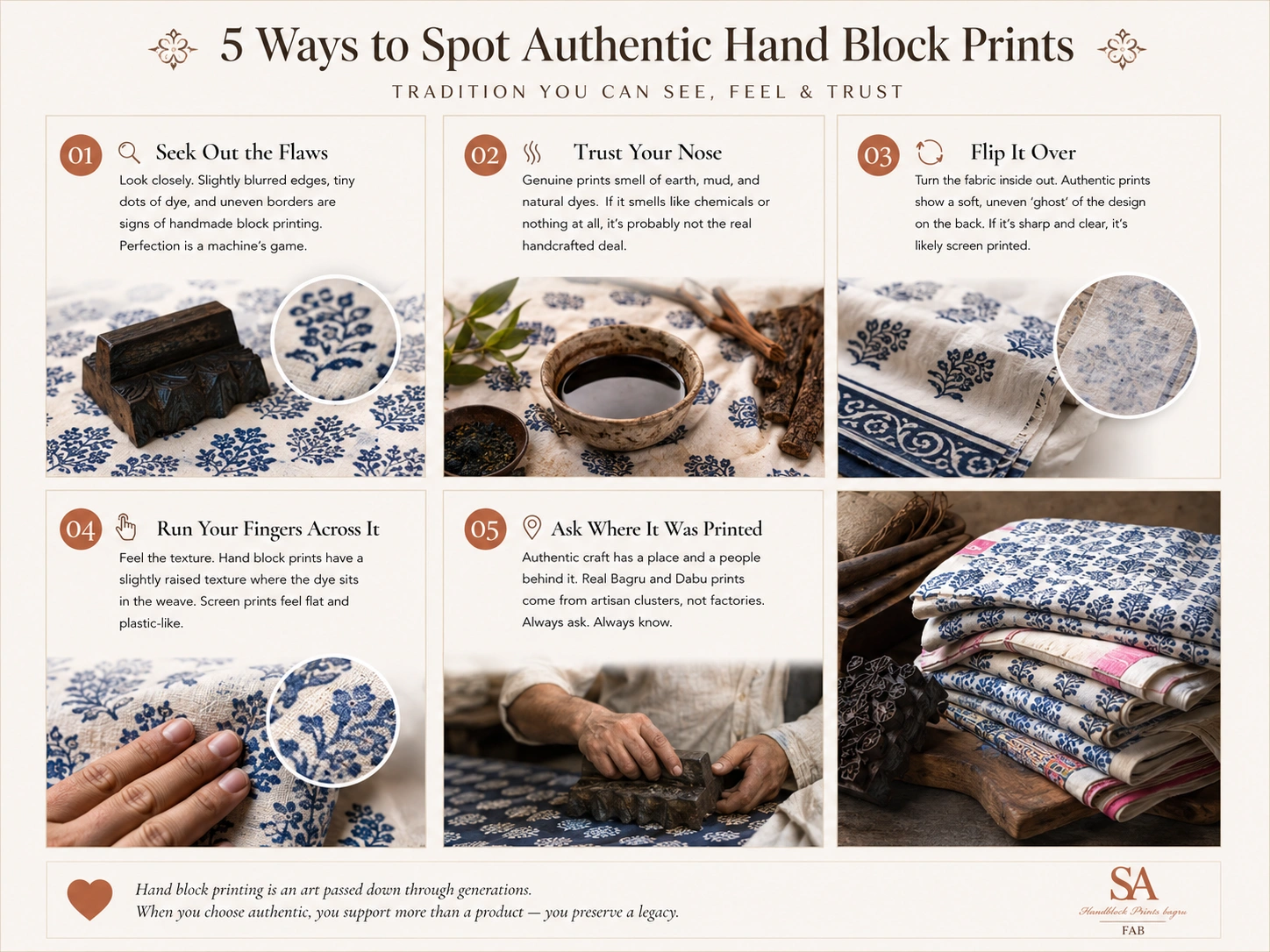
Seek Out the Flaws
Machines demand perfection. Humans make mistakes, and that's the whole point. Spread the fabric flat on a table. Check the edges of a motif — are they slightly blurred? Look for a stray dot of dye. Check where one block impression meets the next, since the border rarely lines up exactly.
When an artisan slams a carved wooden block onto cloth, human physics takes over. Skilled printers place a small pin mark at the edge of each impression to line up the next one by eye, never by machine guide. If your new kurta looks flawless under a magnifying glass, it's a fake.
Trust Your Nose
Bury your face in the cloth and take a real breath. Genuine Bagru and Dabu prints carry the actual scent of the earth they were made from — wet mud, tree gum, boiled plant dyes. Freshly printed cotton smells raw, a little dirty, like wet soil right after the first monsoon rain.
A machine-printed fabric smells like nothing at all, or worse, sharp and chemical, like a fresh plastic packet. If your brand-new Ajrakh saree smells like a sterile warehouse instead of soil, walk away.
Flip It Over
The back of the fabric never lies. Turn the cloth inside out. When an artisan presses a block down, the dye punches straight through the weave. You'll see a ghost of the same pattern bleeding through to the reverse side — softer, paler, but unmistakably there.
Factory rotary screens lay a thin film of colour onto the surface only, so the back stays stark white, untouched. Real block printing leaves its fingerprint on both sides of the cloth. A fake leaves it on one.
Run Your Fingers Across It
Close your eyes and drag your fingertips slowly across a printed section. Real block printing changes the physical structure of the cloth, not just its colour. You can often feel a faint dent where the carved wood pressed into the weave.
A fake print feels like a sticker laid on top of plain cotton — flat, slightly stiff. Genuine handcrafted sarees and co-ord sets breathe differently. They soften with every wash instead of cracking or peeling.
Ask Where It Was Printed
This one costs nothing. Ask the seller directly: where exactly was this printed, and by whom? A maker who can name the village, the workshop, or the artisan family answers without hesitating.
A reseller hiding a factory print gives you something vague — "traditional Indian print," "handmade style" — and changes the subject fast. Bagru's hand block print also carries Geographical Indication status. A seller who can't name the village rarely sells the real thing.
A Quick
Side-by-Side
| What you check | Genuine handblock print | Machine / digital fake |
|---|---|---|
| Edges of the motif | Slightly soft, occasional blur | Sharp, pixel-perfect |
| Pattern repeat | Tiny natural shifts between blocks | Identical, mathematically aligned |
| Smell | Earthy, like wet mud or fermented indigo | Odourless, or chemical-sharp |
| Reverse side | Dye visibly bleeds through | Stays mostly white, untouched |
| Feel under fingers | Slight texture, dye sits in the weave | Flat, sits on top like a sticker |
| Seller's answer on origin | Names the village or artisan family | Vague, avoids specifics |
Why Any of This
Matters
Why bother checking at all? Because every rupee you spend on a real piece reaches a family in Jaipur that's been printing this way for generations. It keeps a village working instead of watching the craft die out for cheaper, faster alternatives. And selfishly, you get something better too — fabric that holds the sweat, the calluses, and the actual hands of a real person, not a barcode off an assembly line.
If you want to go deeper into how the craft actually works before you shop, our guide to the art of hand block printing walks through the full process from carved block to finished cloth. And if you're trying to tell two specific Rajasthani traditions apart, our Ajrakh vs Dabu printing comparison breaks down exactly how mud-resist Dabu differs from the geometric, double-sided Ajrakh print.
Where to Find
The Real Thing
Every piece we sell at SA Fab — from Chanderi sarees to fabric sold by the metre — passes every test above, because nothing leaves our workshop in Ganga Vihar, Bagru, until an actual Chhipa artisan has hand printed it with a carved wooden block and natural dye. If you'd rather get the fabric and stitch it yourself, our Ajrakh print fabric and Dabu print fabric both ship in 10-metre rolls with no minimum order, so you can run every test yourself before you cut a single piece.
Frequently Asked Questions
How can I tell if a saree is hand block printed or machine printed?
Does fake handblock print smell different from real handblock print?
Why do real handblock prints look imperfect?
Is it worth paying more for genuine handblock printed fabric?
Can a seller fake the smell or feel of a handblock print?
"Every rupee spent on a real piece reaches a family in Jaipur that's been printing this way for generations. That's not a marketing line — that's where the money actually goes."Saloni Agrawal — Founder, SA Fab
Keep the Thwack Going
Smell the cotton. Trace the blurred edges. Flip the fabric over. A few seconds of attention is the difference between a soulless copy and fabric that carries a real person's care.
Not sure if yours is genuine? WhatsApp us a photo