
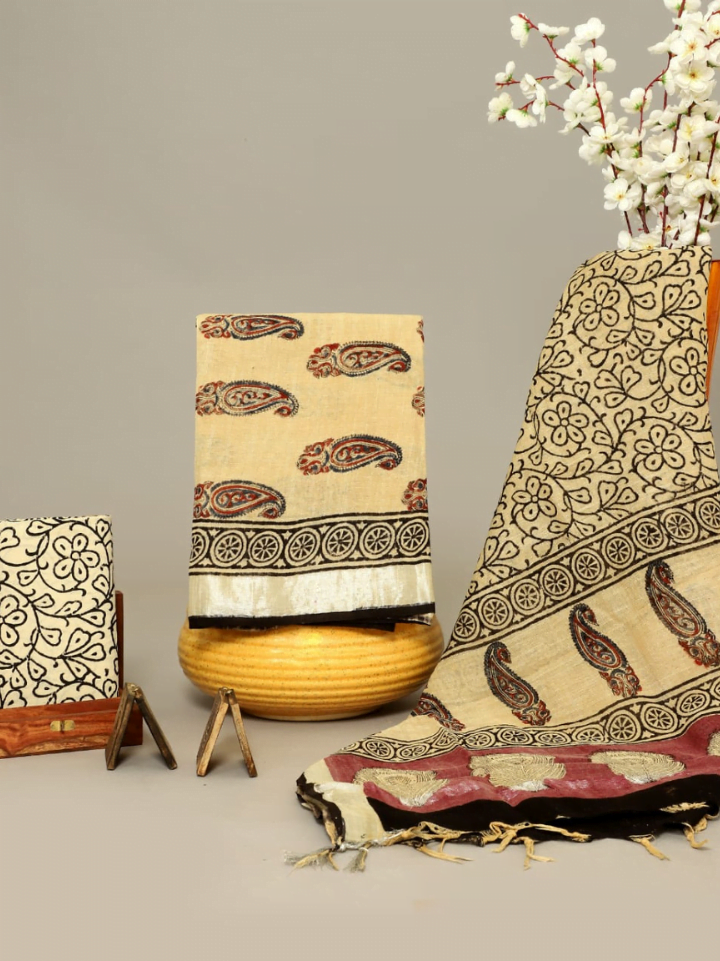
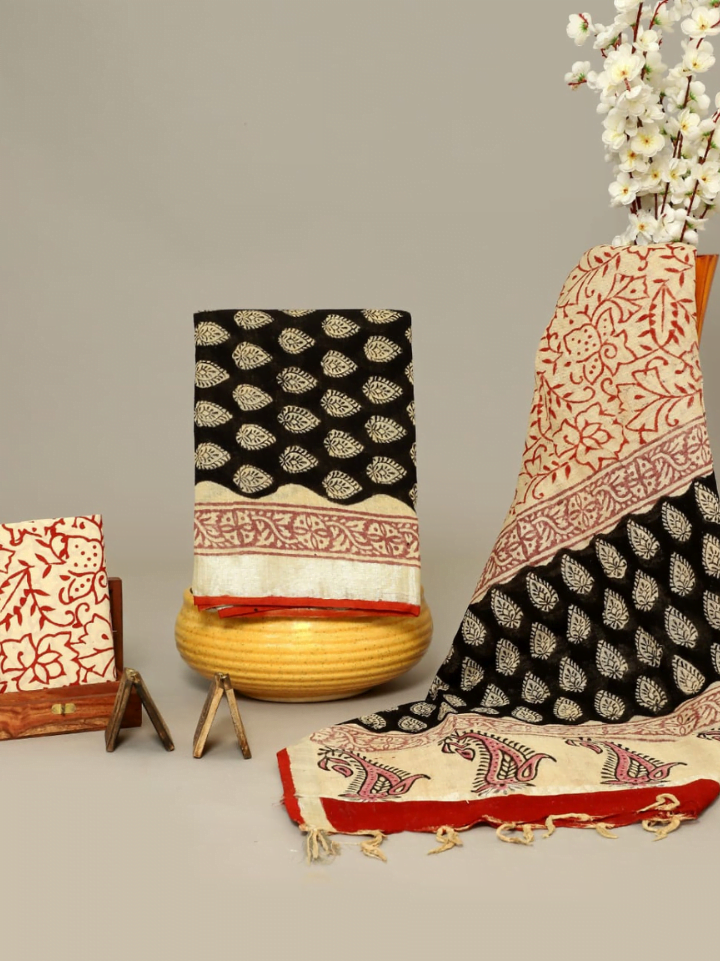
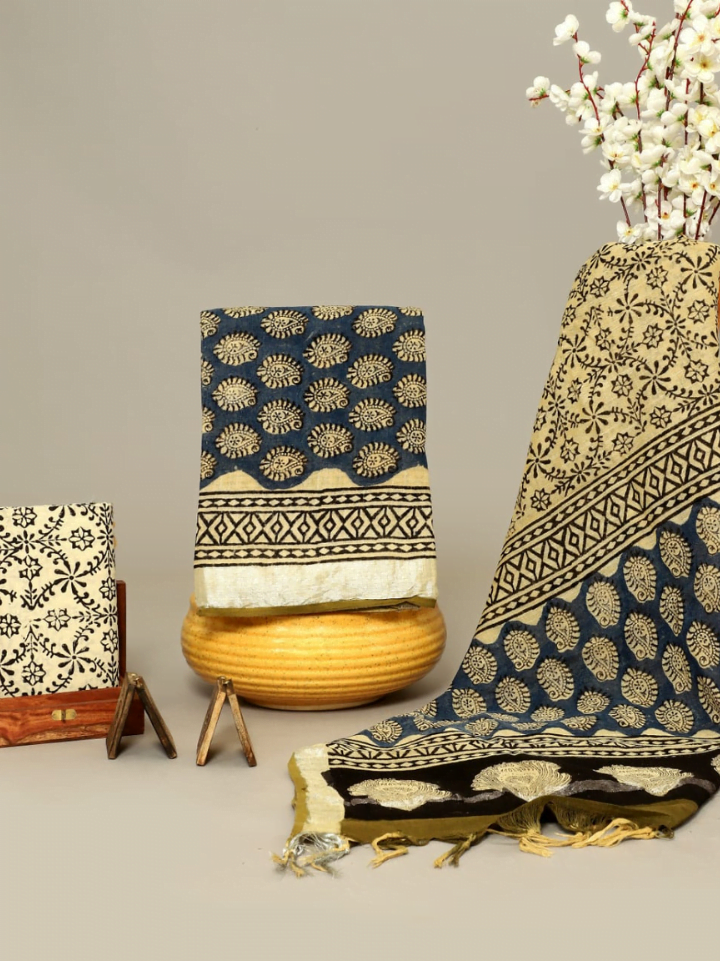
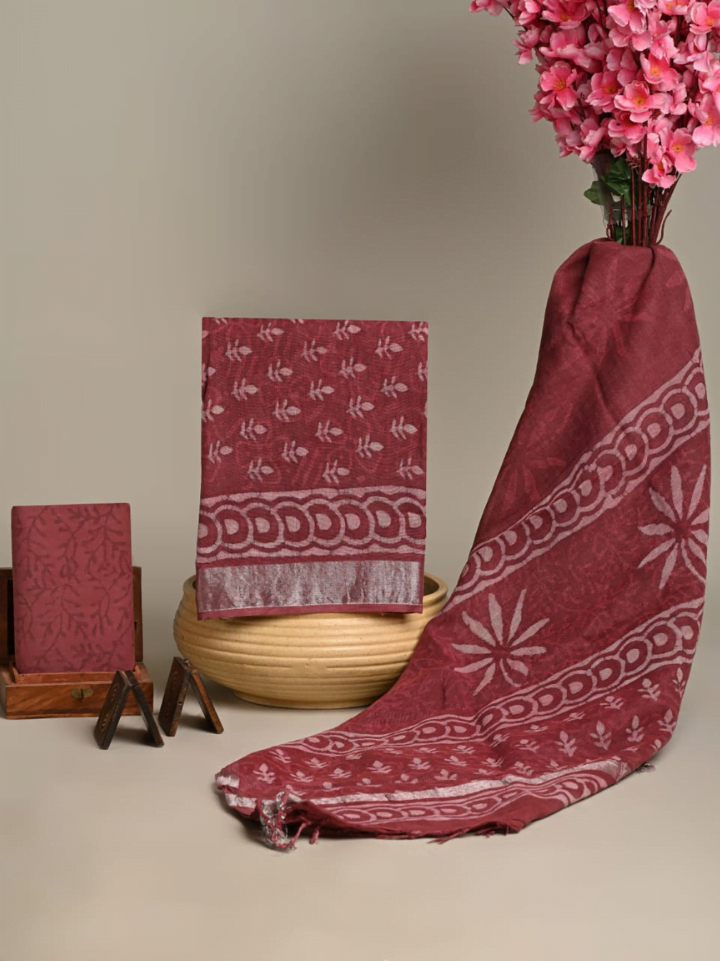
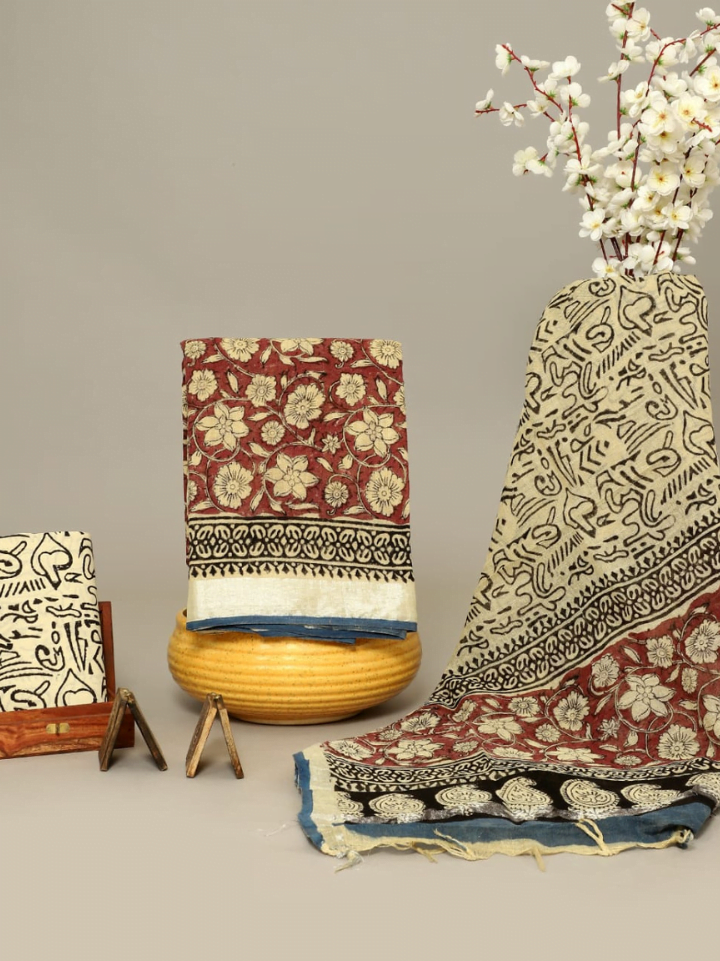
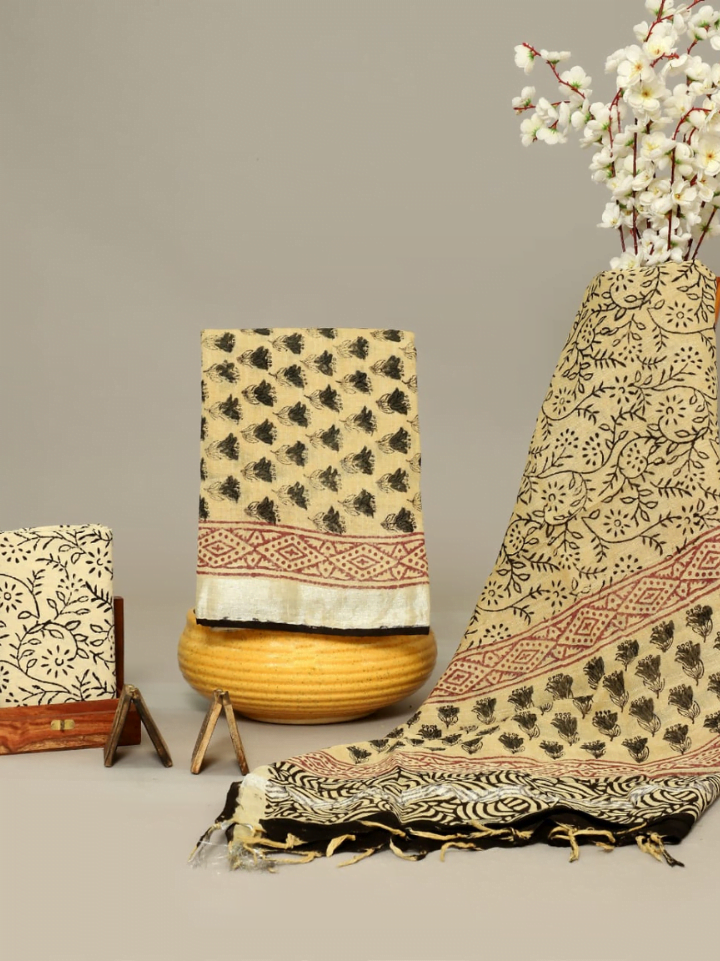
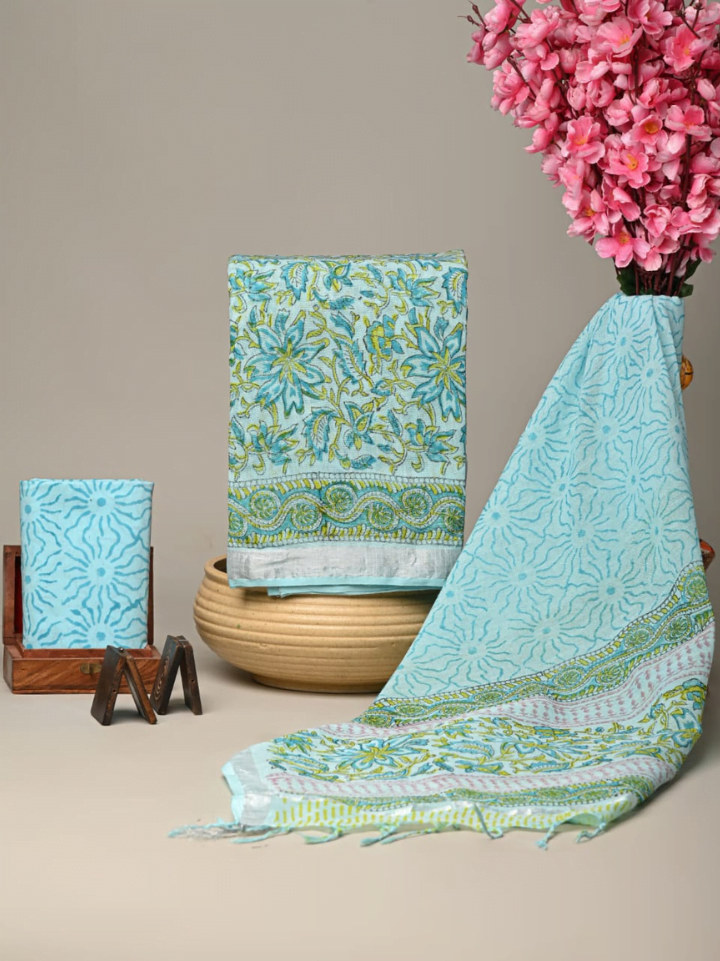
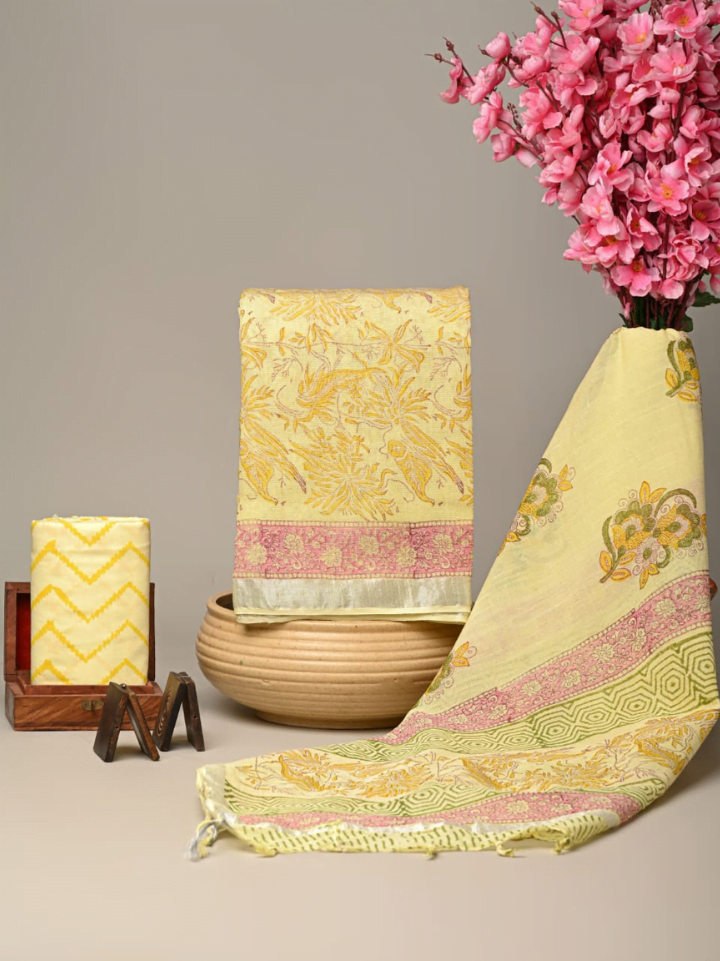
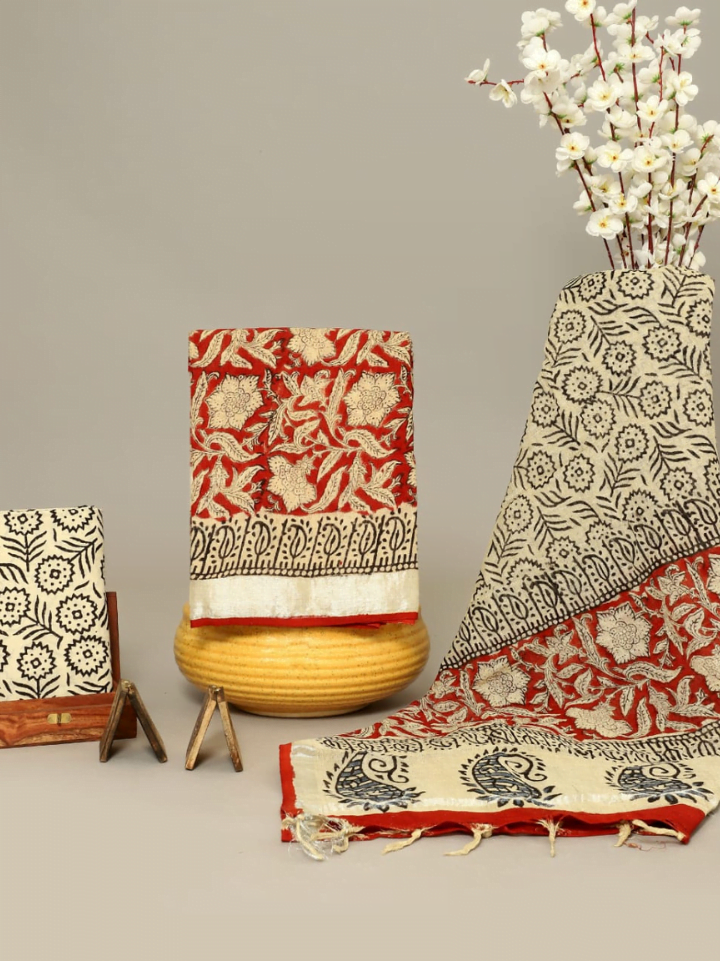
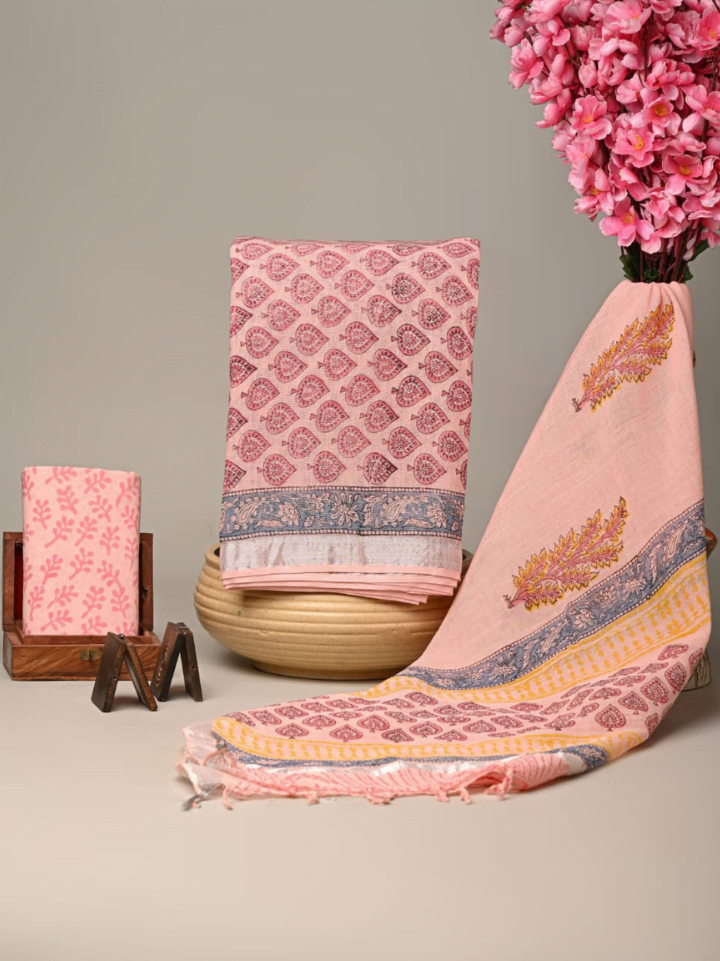
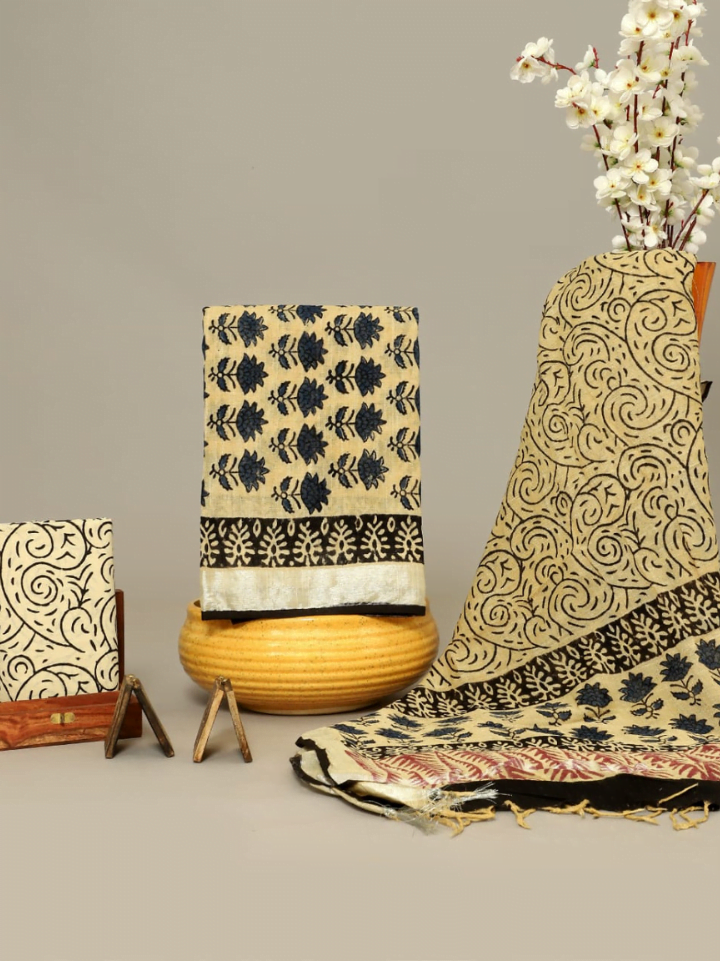
Unstitched Linen Suit — Block Printed in Bagru, Jaipur
Every linen suit in this collection is an unstitched three-piece set — block printed by hand in Bagru, Rajasthan, on pure linen fabric. The Chhipa community artisans press hand-carved wooden blocks into natural dye paste and stamp the motifs across pure linen — one impression at a time. The result is a linen printed suit that combines the craft authenticity of Bagru block printing with the superior breathability of pure linen — the most breathable natural fabric available for Indian summer wear.
Each set includes three unstitched pieces: a pure linen kameez piece (2.5 metres), a pure linen dupatta (2.5 metres), and a cotton bottom piece (2.5 metres). The kameez and dupatta are both pure linen — block printed in the same natural dye colour and motif. The bottom is pure cotton cambric — a finer, softer cotton chosen specifically because it sits against the skin and needs to breathe as well as the linen top.
You take all three pieces to your tailor. You choose the cut, the neckline, the sleeve style, and the bottom silhouette. We supply the best possible fabric combination for summer ethnic dressing — block printed in Bagru, natural dyes throughout, pure linen where it matters most.
Why Pure Linen Is the Right Fabric for a Summer Suit
Linen is woven from the fibres of the flax plant. It is the oldest textile fibre used by humans — and it remains the most breathable natural fabric available for warm-weather dressing. Here is why that matters for an unstitched suit specifically:
Linen has a more open weave structure than cotton. Air moves through linen fabric more freely than through cotton of equivalent weight. As a result, a linen kameez stays cooler against the skin in peak Indian summer heat than a cotton kameez of similar thickness. Linen also wicks moisture away from the skin faster than cotton — so it stays comfortable during both indoor and outdoor wear in humid conditions.
Furthermore, linen gets softer with every wash rather than pilling or losing shape. A well-cared-for linen suit improves with repeated wear — which is the opposite of how synthetic summer fabrics behave. The characteristic slight texture of linen also means the natural dye block print sits on the surface with a visual depth that smooth cotton does not provide. The combination of linen’s open weave and natural dye’s plant-based pigment creates a print that breathes visually as well as physically.
For our full guide to linen sarees and linen as a fabric for Indian summer wear, read our article on 10 reasons to buy pure linen — all the fabric knowledge in that guide applies equally to linen suit sets.
What’s Included in Each Linen Suit Set
Kameez Piece — 2.5 Metres of Pure Linen
The top fabric is pure linen — block printed in Bagru using natural dyes. At 2.5 metres, this is sufficient for a long straight kameez, an A-line kameez, or a shorter kurta in most sizes up to XL. For a heavily flared anarkali or a kalidar kameez with extensive gathers, confirm your tailor’s yardage requirement before ordering. Linen has a characteristic natural drape — it falls with a slightly heavier hand than cotton, holds pleats well, and maintains its shape through a full day’s wear without going limp in heat the way some cotton blends do.
Dupatta — 2.5 Metres of Pure Linen
The dupatta is also pure linen — block printed in the same or a complementary natural dye palette as the kameez piece. A linen dupatta has a characteristic drape quality: slightly heavier than a cotton dupatta, which means it holds a one-shoulder or double-shoulder drape more firmly without needing pinning. At 2.5 metres, it covers all standard draping styles. The linen dupatta also makes an excellent scarf for travel and outdoor occasions because it breathes better than cotton and does not cling in heat.
Bottom — 2.5 Metres of Pure Cotton Cambric
The bottom fabric is pure cotton cambric — a fine, smooth-finish cotton. Linen is specifically not used for the bottom piece for a practical reason: linen can feel slightly rough against the inner thigh in a salwar or trouser cut that is worn for long periods. Cotton cambric is softer and smoother in sustained skin-contact wear. Furthermore, cambric is easier for tailors to work with for fitted churidar or straight pant cuts. The cambric bottom is block printed in a complementary colour from the same natural dye palette, so all three pieces coordinate as a coherent set.
What’s in This Collection
11 unstitched linen suits across a wide colour palette and two print styles:
Floral & Botanical Prints
The majority of our linen suit collection carries floral and botanical block print motifs — the most natural vocabulary for linen’s texture and drape. Our Moonstone Blue Floral, Pastel Yellow Floral, Dusty Rose Small Plant Motif, Light Red Brown Floral, Misty Gold Floral, Turkey Red Peanut Floral, Winter Yellow Floral, and White Betel Motif styles all sit in this group. The soft-edged quality of a hand-pressed botanical motif on linen’s slightly textured surface creates a visual combination that is distinctive from the same motif on smooth cotton. These are the most versatile styles for casual festive wear, office ethnic dressing, and summer occasion wear.
Small Motif & Heritage Prints
Our Black Small Motif, Biscotti Traditional Motif, and Dark Bluish-Gray & Beige styles carry more composed, structured print vocabularies. These are the most office-appropriate styles in the collection — the smaller, more geometric prints carry a professional ethnic register without the visual boldness of the large floral styles. The Black Small Motif is the most versatile for formal ethnic office wear — the deep iron black natural dye ground with a subtle repeat print reads as considered and professional in most office environments.
Which Linen Suit for Which Occasion
Office & Professional Wear
Linen is one of the most practically suited fabrics for ethnic office wear. It stays crisp through air-conditioned offices, holds its shape through long meetings, and does not wrinkle as visibly as cotton when sat in for hours. Our small motif and heritage styles — Black Small Motif, Biscotti Traditional Motif, Dark Bluish-Gray — are the most composed office choices. Get them stitched as a straight or A-line kameez with a straight pant or churidar for the cleanest professional silhouette. Since the unstitched suit sets collection also includes cotton, Kota Doria, and Chanderi options, linen suits sit at the most breathable end of that range for summer office wear.
Festive & Occasion Wear
Our floral linen suits — Moonstone Blue, Turkey Red, Misty Gold, Light Red Brown — carry the festive register through colour and motif depth rather than embellishment. Natural dyes on linen have a characteristic visual richness: the slight texture of the linen surface adds dimension to the print that smooth synthetic fabrics cannot achieve. Pair these with a more elaborate neckline or back detail from your tailor to shift the linen suit into celebration territory for Navratri, Diwali, and family occasions.
Summer Daily Wear
Our lighter-palette styles — Dusty Rose, Pastel Yellow, White Betel Motif, Winter Yellow, Misty Gold — are the best everyday summer choices. The lighter ground colours reflect heat rather than absorbing it. The pure linen fabric breathes more freely than any cotton alternative. As a result, these styles are genuinely comfortable as daily wear through peak Indian summer months — something that is difficult to achieve with any synthetic fabric regardless of weight.
Two Natural Materials — One Craft Origin
Our linen suits bring together two natural material traditions. The linen fabric is woven from flax fibre — a plant-based textile that has been used for clothing for over 6,000 years. The block printing is done by Chhipa community artisans in Ganga Vihar, Bagru using natural dyes — madder root, indigo plant, harda seed, iron solution. Both materials are plant-based. Both are natural. Neither involves synthetic chemical processes in production or in the dye.
We work directly with Chhipa artisans — no factory intermediary, no wholesale markup. Fair wages go directly to the craftspeople. As a result, when you buy a linen suit from SA Fab, you buy from the source — and the price reflects that direct artisan relationship rather than multiple layers of margin. For the full story of how block printing works, read our guide to the art of hand block printing.
How to Care for Your Linen Suit Fabric
- Pre-wash before cutting and stitching. Linen shrinks more than cotton in the first wash — typically 5 to 8% in length. Always cold pre-wash all three pieces before giving them to your tailor. This sets the linen to its final dimensions and removes excess natural dye in the same step.
- Wash separately in cold water. Natural dye release in the first 2–3 washes is normal. Wash all three pieces separately first to prevent colour transfer.
- Hand wash or gentle cold machine cycle. Linen is stronger than cotton when wet but can distort if machine-washed on a heavy cycle. A gentle cold machine cycle is fine after the first few hand washes.
- Never wring linen. Wringing distorts the weave. Gently press excess water out instead.
- Dry flat or hanging in shade. Direct sunlight fades natural dyes over time. Linen dries quickly in shade — usually faster than cotton of similar weight.
- Iron while slightly damp on medium heat. Linen irons most easily when slightly damp. Medium heat works well. Iron on the reverse side to protect the block print surface.
Frequently Asked Questions
What is included in one linen suit set?
Each set includes three unstitched fabric pieces: a 2.5-metre pure linen kameez piece, a 2.5-metre pure linen dupatta, and a 2.5-metre pure cotton cambric bottom piece. All three are block printed by Chhipa artisans in Bagru using natural dyes. No stitching is included — you take all three pieces to your tailor. The kameez and dupatta are pure linen; the bottom is pure cotton cambric chosen for its softness and comfort in sustained skin-contact wear.
Why is the bottom piece cotton cambric rather than linen?
Linen has a characteristic texture that is excellent for a kameez and dupatta but can feel slightly rough against the inner thigh in a salwar or trouser that is worn for long periods. Cotton cambric is softer, smoother in skin-contact wear, and easier for tailors to work with for fitted churidar or straight pant cuts. The natural dye palette of the cambric bottom coordinates with the linen kameez and dupatta, so all three pieces sit together as a coherent set despite using different fabrics for the top and bottom pieces.
Does linen shrink after washing?
Yes — linen shrinks more than cotton in the first wash, typically 5 to 8% in length and 2 to 3% in width. This is why pre-washing before cutting and stitching is essential. Always cold pre-wash all three pieces and allow them to dry completely before giving them to your tailor. Factor this shrinkage into your yardage discussion with the tailor — 2.5 metres pre-shrunk is approximately 2.3 to 2.35 metres of usable fabric. For very long kameez styles, confirm with your tailor that 2.5 metres is sufficient after accounting for shrinkage.
Is a linen suit cooler than a cotton suit?
Yes — linen is more breathable than cotton of equivalent weight. Linen fibre has a more open weave structure than cotton, which allows more air circulation through the fabric. It also wicks moisture away from the skin faster. As a result, a linen kameez stays cooler than a cotton kameez in peak Indian summer heat. For outdoor occasions, humid conditions, and long summer days, linen is the better choice. For air-conditioned offices where breathability matters less, both linen and cotton perform similarly — but linen holds its shape better through a full air-conditioned working day.
How much fabric is 2.5 metres of linen — is it enough for my kameez?
After accounting for the typical 5 to 8% pre-wash shrinkage, 2.5 metres of linen gives approximately 2.3 to 2.35 metres of usable fabric. This is sufficient for a straight, A-line, or short kurta kameez in most sizes up to XL with some remainder. For a long anarkali or kalidar kameez with heavy gathers, confirm your tailor’s exact yardage requirement before ordering. If you need additional yardage in the same print, WhatsApp us and we will advise on availability.
Explore the Full Unstitched Suit Collection
Our linen suits are part of a wider unstitched suit collection. Here is how they compare to the other fabric options:
- Cotton Suit Sets — pure cotton kameez + cotton dupatta + cotton bottom. The most affordable option. Good breathability, slightly less than linen.
- Maheshwari Suit Sets — Maheshwari silk kameez + Maheshwari silk dupatta + cotton cambric bottom. The most lustrous option with a silk sheen.
- Chanderi Suit Sets — Chanderi silk-cotton kameez + dupatta + cotton bottom. Softer and more fluid than Maheshwari, with a gentle natural sheen.
- Kota Doria Suit Sets — fine Kota Doria cotton-silk kameez + Kota dupatta + cotton bottom. The lightest and most translucent option in the collection.
- Modal Silk Suit Sets — modal silk kameez + modal dupatta + cotton bottom. The softest drape in the collection, with excellent colour saturation for natural dyes.
- All Unstitched Suit Sets — browse the complete unstitched suit collection across all six fabric types.
- Ready-Made Block Printed Suits — fully stitched suits in standard sizes if you prefer ready-to-wear over unstitched.
- Pure Linen Sarees — linen in saree form if you want the same fabric in a drape silhouette rather than a stitched suit.
Free Shipping · 7-Day Returns · Directly from Bagru
Every linen suit set ships free across India. Worldwide delivery is also available. If the colour or fabric is not right on arrival, our 7-day easy exchange policy makes it simple to resolve. We accept UPI, Visa, Mastercard, RuPay, and net banking.
For help choosing the right suit style, colour, or guidance on yardage for your preferred silhouette — WhatsApp us between Monday and Saturday, 10am to 7pm IST.