
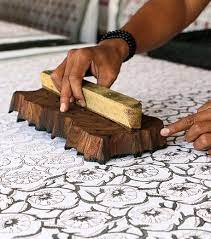
There is a lane in Bagru called Chhipa Mohalla. Walk into it on any morning and the air hits you before anything else — wet cotton, fermented indigo, the particular sharpness of clay baking in Rajasthan heat. Fabric hangs from every terrace, every rooftop, every available inch of sky, in blues and madder reds and earthy creams. If you stand still long enough, you'll hear it. Thwack. A pause. Thwack again. The sound of a block meeting cloth. The sound that has defined this lane for 450 years.
This is the story of Bagru print — not as a product or a trend, but as a life. The life of a community that has been doing one thing, the same way, with the same wooden blocks, the same river clay, the same devotion, for longer than most nations have existed. We work inside this story every day at SA Fab, and it is the one I most want people to understand before they hold one of our pieces in their hands.
How It All Began: The Chhipas Find Their River
The origin story of Bagru hand block print, like all the best stories, has more than one version. The one most commonly told among the Chhipa artisan families themselves goes something like this: several centuries ago, the Thakur of Bagru — the local ruler — wanted to establish his town as a centre of textile production. He sent for two families of printers from Isarda, near Sawai Madhopur, people known for their knowledge of natural dye and wooden block technique. They came, looked at the land, and found exactly what they needed: the Sanjaria River, running close by, its banks lined with a particular kind of clay — fuller's earth — that would become the foundation of everything the Bagru print tradition is known for.
Those two families stayed. Others followed. Over generations, the Chhipa community grew around the riverbank, and what began as a small settlement of printing families became a full neighbourhood — the Chhipa Mohalla — that still exists today, still printing, still mixing dyes by hand, still drying fabric on the same sun-baked earth those first families chose to build on.
The word Chhipa itself carries the whole identity of the community inside it. It likely comes from the Gujarati "chhaap," meaning "to print," or possibly from two words in Nepal Bhasa: "chhi" (to dye) and "pa" (to leave in the sun). Either etymology is perfect. The Chhipas are people who print, and people who wait for the sun. Both things are true.
"Those two families looked at the river, felt the clay between their fingers, and decided this was the place. That decision — made centuries ago by people whose names we'll never know — is the reason Bagru print exists today."
Why This Village and No Other
Bagru is 32 kilometres from Jaipur on the Ajmer road. It is not a famous city. It has no palace, no fort worth touring, no obvious reason for the world to know its name. And yet the world does know it — because of the craft.
The geography is not incidental. The Sanjaria River provided the specific mineral-rich clay that Chhipa artisans used as fuller's earth to prepare their fabric, and whose water interacted with natural dyes in a particular way that gave Bagru block print its characteristic depth of colour. The clay is what gives the fabric its warm, off-white base tone before a single block has been pressed. The water is what helps madder root produce that specific deep red, what allows indigo to settle into the weave at the tone Bagru is known for — darker, earthier, quieter than the same dye used elsewhere.
The Sanjaria has not flowed for about fifty years now. The river ran dry — a consequence of the same forces that have threatened traditional crafts across Rajasthan. The Chhipa community adapted, found other water sources, found ways to continue. But older artisans who speak about the river speak about it the way people speak about something they have lost and never quite stopped missing. That loss is part of the story of Bagru print too. Not a footnote. Part of it.
The Royal Seal: When the King Wore a Chhipa's Work
The craft gained its first significant patronage from Bagru's own royal family. The story goes that when the king appeared in public — a rare event, an occasion of significance — he wore a pagdi printed by the Chhipas. It had their patterns on it: the bold florals, the geometric butis, the deep red and black that are the signature colours of traditional Bagru block print. For the artisans watching from the crowd, seeing the king in their work was not just pride. It was proof. Proof that what they made mattered. Proof that this craft had value beyond utility.
That validation from royal patronage embedded the craft into Bagru's identity permanently. You cannot build 450 years of unbroken practice on technique alone. You also need community belief — a shared sense that what you're doing is worth continuing. The king wearing a Chhipa's work gave that belief its first formal shape.
Centuries later, former Prime Minister Indira Gandhi was known to have worn Bagru print sarees — a different kind of royal patronage, but the same principle. The craft reaches the highest rooms in the country and still comes from the same narrow lane in the same small village it has always come from.
The Language of Bagru Motifs
Buti / Buta — Small and large floral motifs, the most recognisable element of Bagru print. Drawn from the plants and flowers of the region.
Jhar — A flowering plant or tree motif, usually running vertically, used as a repeating field pattern across the cloth.
Chopard / Aath Kaliya — Geometric patterns, often used as borders or field fillers alongside floral motifs.
Kamal (Lotus) — A classic Bagru motif, symbolic and recurring across generations of Chhipa family blocks.
Jaal — A trellis or net pattern, usually used as an all-over field print, producing a dense repeat across the entire length of cloth.
The Three Blocks That Make Every Print
A single Bagru block print design is never made with one block. It takes at least three, each with a different purpose, each carved from seasoned teak, rosewood (sheesham), or rohida timber — wood chosen for its hardness, its ability to hold detail, and its behaviour when soaked in the oil that seasons the block before first use.
The Gadh block prints the background — the ground tone that covers the entire field of the cloth before detail is added.
The Rekh block carries the outline — the precise, sharp edge of the motif, the skeleton of the design. This is the block that defines what you're looking at.
The Datta block fills in the colour inside the outline — the body of the flower, the interior of the geometric shape, the dyed mass that sits within the Rekh's lines.
A master printer knows which block to use at which stage, how much dye to load onto each, and how much pressure to apply — more on one edge for even coverage, less on another so the dye doesn't bleed beyond the Rekh's boundary. This is the knowledge that doesn't live in a manual. It lives in hands. And it takes years of those hands doing the same thing, every day, before the prints come out consistently right.
What "Natural Dye" Actually Means in Bagru
The phrase "natural dye" gets used loosely in fashion. In Bagru, it is a specific and exacting thing. Every colour in a traditional Bagru hand block print comes from a plant, a mineral, or a combination of both, and the recipe for each colour is held within Chhipa families as knowledge passed between generations, not written down, adjusted season by season as the quality of the harvest changes.
| Colour | Source | Notes |
|---|---|---|
| Deep red / terracotta | Madder root (Rubia tinctorum) | Requires alum mordant to bond; deepens with washing |
| Indigo blue / navy | Indigo plant (Indigofera tinctoria) | Fermented vat dye; no colour visible until oxidation in air |
| Warm yellow / off-white | Harda seed (Terminalia chebula) | Used as mordant AND dye; gives Bagru its signature base tone |
| Black / dark grey | Syahi — fermented iron & jaggery | Takes weeks to ferment correctly; temperature-sensitive |
| Warm amber / ochre | Pomegranate rind (Punica granatum) | Often used in overdyeing combinations with madder |
None of these are consistent between seasons the way a synthetic dye mixed in a lab is consistent. The madder root from a dry summer produces a slightly different red than one from a wet season. The indigo vat on a cold morning behaves differently than one in peak summer heat. A master dyer adjusts by feel, by smell, by the colour of the water in the vat. This is why mass-produced "natural dye" fabric — produced at scale and speed — almost always uses standardised synthetic approximations rather than the real thing. The real thing requires too much attention, too much knowledge, too much patience to scale.
If you want to understand the full interplay between natural dyes and the hand block printing process step by step, our craft guide covers the complete twelve-stage sequence in detail. And if you're wondering specifically how the mud-resist Dabu technique differs from direct block printing, our Ajrakh vs Dabu comparison separates the two traditions clearly.
The Knowledge That Doesn't Get Written Down
There is a particular kind of knowledge in the Chhipa community that I find myself thinking about often. It is the knowledge that cannot be transferred by writing, by video, by any formal training programme. It lives in the body. In the wrist that knows how much pressure to put on a block. In the nose that tells a dye master his indigo vat is ready. In the eye that sees a print is two shades too light before the cloth has fully dried.
This knowledge passes from parent to child by proximity, not by instruction. A child growing up in a Chhipa household spends years watching before they are trusted to press a block. They absorb information the way children absorb language — not by studying it, but by being surrounded by it, every day, until it becomes instinct.
When a young person from a Chhipa family leaves Bagru for a city job — and many do, because the city offers more money faster and less physical labour — something more than a worker leaves. A generation of accumulated knowledge leaves with them. Not all of it can be recovered by the next family member who stays. This is the quiet emergency inside the story of Bagru print that rarely makes it into the trend coverage or the sustainability reports.
"The block collections held by Chhipa families are not inventory. They are inheritance. Some families have blocks carved by great-grandfathers — specific motifs that exist nowhere else, that cannot be reproduced if the wood finally cracks."
What GI Protection Means — and What It Doesn't
Bagru print received Geographical Indication protection in 2011 (Application No. 137), a legal designation that officially recognises the craft's origin and restricts the use of the "Bagru print" name to fabric genuinely produced using traditional methods in the Bagru region. This matters because the commercial value of the name had long outrun the reality of what was being sold under it — factory-printed synthetic fabric being marketed as "Bagru style" to buyers who didn't know the difference.
GI protection gives the Chhipa community a legal basis to protect their work. What it doesn't automatically provide is the enforcement infrastructure, the market awareness, or the pricing power to make that protection function in practice day-to-day. The gap between a law on paper and a name actually protected in the marketplace is one the craft community is still navigating. We wrote about this in detail in our piece on how to spot fake handblock prints — which is the consumer-facing version of the same problem the GI tag exists to solve.
Why We Work Here — SA Fab and the Chhipa Community
I moved back to Bagru because I couldn't watch this story end from a distance. I had an MBA. I had years in banking. I had every credential for a career that had nothing to do with a printing block or a dye vat. And none of that mattered as much as standing in the Chhipa Mohalla and understanding that what was happening here was irreplaceable — not in the way people use that word to mean rare, but irreplaceable in the literal sense: if the knowledge and the practice and the community all left Bagru, they would not come back.
SA Fab works directly with Chhipa artisans in Ganga Vihar, Bagru — no factory in between, no wholesale layer, no synthetic dye substitution. When you buy a Bagru print cotton saree or a Bagru block print suit set from us, the money reaches the workshop where it was made. Not most of it. A meaningful amount of it. Enough to make staying in Bagru a viable choice for the artisan family that made your piece, rather than a sacrifice.
That's not charity. That's just not adding a middleman who doesn't need to be there.
Women
Bagru Print Sarees
Women
Bagru Block Print Suit Sets
Fabric
Dabu Print Fabric
Fabric
Ajrakh Print Fabric
Frequently Asked Questions
What is Bagru print and where does it come from?
Who are the Chhipa community?
What makes Bagru print different from Sanganeri or Ajrakh print?
What are the traditional motifs used in Bagru block print?
How do I know if a Bagru print I'm buying is genuine?
Free shipping across India · Worldwide delivery available · 7-day easy returns and exchange
Questions about sourcing or our artisan community? WhatsApp us — Monday to Saturday, 10am to 7pm IST.